Rajarani Temple, Bhubaneswar — History, Architecture, Entry Fee & Timings
Of the dozens of surviving temples scattered across Bhubaneswar, Rajarani is the one that most rewards slow looking. It has no presiding deity, no queue, no ritual calendar and no priests — and precisely because of that, it is the one place in the old temple city where you can walk right up to eleventh-century Kalinga sculpture and study it at arm’s length, in silence, on a lawn.
It is also the temple that art historians reach for when they want to show how far Odishan builders had travelled by the middle of the eleventh century. The tower is not a single mass but a cluster: a central spire ringed by tiers of miniature replicas of itself, climbing in receding ranks toward the crown. Nothing else in Bhubaneswar looks quite like it, and the closest visual parallels are nearly a thousand kilometres away in Khajuraho.
When It Was Built, and by Whom
Rajarani belongs to the mid-eleventh century, during the long temple-building climax of the Somavamsi dynasty — the line that ruled Odisha between the ninth and twelfth centuries and gave Bhubaneswar most of the monuments visitors come to see today. On stylistic and epigraphic grounds it is usually placed somewhere between roughly 1000 and 1040 CE, though no inscription on the building itself records a date.
That placement matters more than it might sound, because it puts Rajarani at a very specific point in a sequence. Behind it stands the small, jewel-like Mukteswara Temple of the late tenth century, where the Kalinga vocabulary was perfected at miniature scale. Ahead of it stands the colossal Lingaraj, where that vocabulary was scaled up into something monumental and civic. Rajarani sits between the two — and rather than simply splitting the difference, its builders used it to experiment.
Several accounts attribute the commission to King Indraratha, a Somavamsi ruler, and record the temple’s original name as Indreswara — either after that patron, or after the form of Shiva installed within. This attribution is widely repeated and is plausible on stylistic grounds, but it is an interpretation drawn from later tradition and comparative dating rather than a fact the building states about itself. It is worth holding a little loosely.
The Stone That Renamed the Temple
The name “Rajarani” has nothing to do with any king or queen, despite how naturally it translates that way. It comes from the rock.
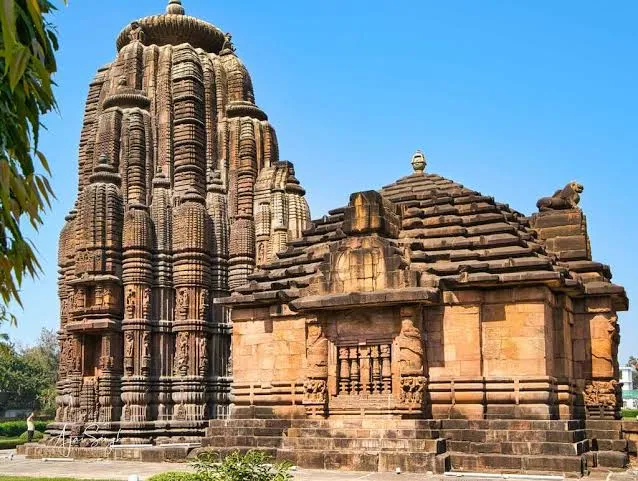
The temple is built from a fine-grained local sandstone that Odia masons called Rajarania — a stone with an unusual warm cast that reads as dull red in flat light, amber in the late afternoon, and almost bronze at sunset. As the temple’s religious life faded and its original dedication was forgotten, the building came to be known simply by the material it was made of. The stone outlasted the god.
This is not merely a naming curiosity. It changes how you should plan a visit. Rajarania sandstone is at its most dramatic in raking light, which is why photographers time their visits for the first and last ninety minutes of the day, and why a midday walkthrough — when the sun flattens everything — can leave visitors wondering what the fuss is about.
The Empty Sanctum
Step through the porch into the inner chamber and you find nothing. The garbhagriha — the sanctum that in any other Odishan temple would hold a lingam or an image — is bare, dark and entirely empty.
This is the single most discussed thing about Rajarani, and there is no settled explanation. Two accounts are usually offered:
It was never consecrated. On this reading the temple was structurally finished but abandoned before the Prana Pratishtha rite that installs and animates the deity — perhaps because the patron died, or because the dynasty’s fortunes turned before the ceremony could be held. A temple without that rite is architecture, not a shrine, and would never have acquired a priesthood or a congregation.
The image was lost. The alternative holds that a deity was installed and later removed — plundered during one of the region’s medieval conflicts, destroyed, or carried to an active temple nearby for safekeeping during a period of danger and never returned.
What is not in doubt is the temple’s affiliation. The building is unambiguously Shaivite in its iconography: the doorway is flanked by Dvarapalas bearing tridents, and the carved panels include the marriage of Shiva and Parvati and a dancing Nataraja. Whatever once stood in that chamber, it was a form of Shiva.
The practical consequence for a visitor is that Rajarani is a monument, not a working temple. There is no darshan, no queue, no prasad, no dress code enforced by custom, and — unusually for Bhubaneswar — no restriction on who may enter. Anyone can walk in. In a city where two of the largest temples bar non-Hindu visitors from the interior entirely, that makes Rajarani quietly one of the most accessible major monuments in Odisha.
The Architecture: Where Kalinga Design Experimented
Rajarani follows the standard two-part Kalinga plan, raised on a platform:
| Component | Order | What it does |
|---|---|---|
| Vimana (Deul) | Rekha — curvilinear tower | Houses the sanctum; carries the clustered spires that make the temple famous |
| Jagamohana | Pidha — stepped pyramid | The assembly hall in front, deliberately left plainer so it does not compete with the tower |
The tower is laid out on a pancharatha plan — five vertical projections per face — and this is where Rajarani departs from its neighbours. Instead of rising as one continuous curved mass, the central spire is surrounded by tiers of angashikharas: miniature replicas of the tower itself, clustered against its body and diminishing as they climb.
The effect is hard to convey in words and obvious the moment you stand beneath it. The tower stops reading as a single object and starts reading as a mountain — a central peak with subsidiary summits gathered around its base, receding upward toward the heavy fluted amalaka disc at the crown. Your eye is pulled up through a series of stepped pauses rather than sliding up one unbroken curve.
That clustered-spire idea is the standard feature of the Central Indian nagara style, above all at Khajuraho, and it is genuinely rare in Odisha. Whether Rajarani’s builders arrived at it independently or were responding to ideas travelling along trade and pilgrimage routes is an open question — but the resemblance is close enough that the temple is frequently described as Odisha’s most Khajuraho-like building.
The Jagamohana, by contrast, is restrained almost to the point of austerity. This is a deliberate compositional choice, not a shortfall: the hall’s plain stepped roof gives the eye somewhere to rest and makes the tower beside it look taller and busier than it otherwise would.
The Sculpture
Rajarani’s exterior is routinely called a symphony in stone, and unlike most such phrases it earns itself. The carving divides into three distinct programmes.
The Ashta-Dikpalas. Around the base of the tower stand the eight guardians of the directions, each near-life-size, deeply cut, and identifiable by attribute and mount: Indra in the east, Agni southeast, Yama south, Nirriti southwest, Varuna west, Vayu northwest, Kubera north, Ishana northeast. Finding all eight is the single best way to structure a walk around the building — it takes you right around the tower at a deliberate pace and forces you to look closely. This is the most complete and best-preserved set of directional guardians on any temple in Bhubaneswar.
The Nayikas and Alasa Kanyas. Filling the wall surfaces between and above them are female figures in secular, domestic and unguarded moments: a woman studying herself in a hand mirror, another fastening an anklet, one turning to listen to a companion, one holding a child, one reaching up to a tree branch, several with instruments. These are not goddesses. They are people, and the sculptors clearly enjoyed carving them — the postures have a relaxed asymmetry that formal devotional sculpture rarely permits.
The Mithuna panels. Set into the deeper niches are amorous couples, carved with the same anatomical confidence as everything else on the building. In the Indian temple tradition these panels are read as emblems of fertility, auspiciousness and cosmic union rather than as illustration, and their presence at Rajarani is one more point of resemblance to Khajuraho. They are a genuine part of what visitors come to see, and they are discussed openly on site.
Ruin, and the 1903 Restoration
Without a deity, Rajarani had no congregation; without a congregation, it had no one to maintain it. By the nineteenth century the temple had been standing unattended for generations, its platform buried, its surroundings gone to scrub, stonework loosened and displaced.
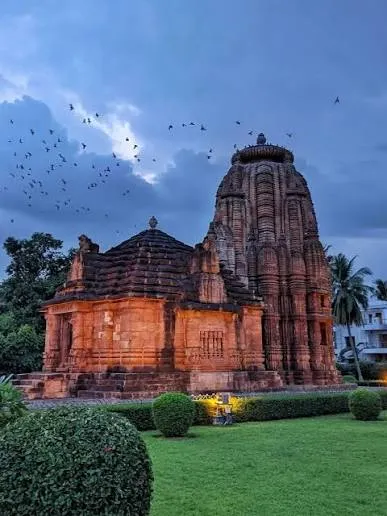
Its rescue came from the recognition that its artistic value was independent of its religious status. Colonial-era conservation work culminated in a thorough refurbishment completed in 1903, which stabilised the structure and cleared the site. The temple has been protected ever since, and is today maintained by the Archaeological Survey of India as a monument of national importance.
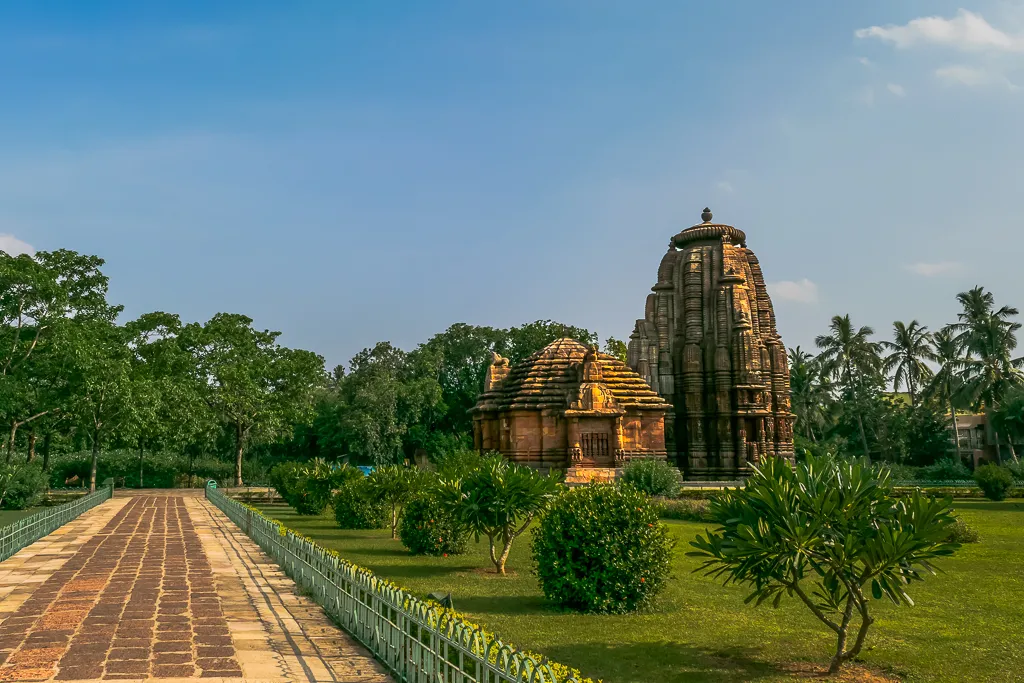
That history explains the setting you find today, which surprises people expecting the density of the old town. Rajarani stands alone on a wide, mown, garden-like lawn with clipped hedges and a paved approach walk — closer in feel to a sculpture park than to a temple precinct. It is a conservation landscape, not a historical one, but it serves the building well: you can walk a complete circuit at a distance and see the whole composition, which is impossible at the crowded Lingaraj complex.
The Rajarani Music Festival
Once a year the empty temple gets an audience. The Rajarani Music Festival, organised by the state tourism department, is held over three days in January, with the lawns turned into an open-air auditorium and the illuminated temple standing as the backdrop.
The programming is classical and deliberately broad — Hindustani and Carnatic vocal and instrumental traditions alongside Odissi music — and draws performers of national standing. Hearing a raga unfold in the open winter air with eleventh-century carving lit behind the stage is the kind of thing that justifies planning a trip around a date.
If you want to attend, check the exact dates with Odisha Tourism before booking: the festival is an annual January fixture but the specific days shift from year to year, and Bhubaneswar hotel rooms tighten noticeably across that weekend.
Timings, Entry Fee and How to Visit
Timings: the monument is open every day of the week, from 6:00 AM to 9:00 PM.
Entry tickets:
| Visitor | Fee |
|---|---|
| Indian nationals, SAARC and BIMSTEC visitors | ₹25 |
| Foreign nationals | ₹250 |
| Children under 15 | Free |
Fees and hours at ASI monuments are revised periodically — worth confirming on the day if it affects your plans.
When to go. October to March is the only comfortable window; Bhubaneswar between April and June is punishing, and the site offers almost no shade. Within the day, aim for 6:30–9:00 AM or 4:00 PM to closing. The late slot is the better of the two if photography matters to you, because that is when the Rajarania sandstone does the thing it is named for.
How long to allow. Forty-five minutes to an hour is enough to walk the full circuit, find all eight Dikpalas and look properly at the wall sculpture. There is no interior to queue for, so the visit is entirely self-paced.
Getting there. Rajarani sits in the Old Town, close to the Bindusagar tank and within a short drive of both Lingaraj Temple and Mukteswara Temple. The three are almost always done as one half-day circuit, and the chronological order — Mukteswara, then Rajarani, then Lingaraj — happens to trace the evolution of Kalinga architecture in the right sequence, which makes a far more coherent morning than visiting them at random.
Biju Patnaik International Airport is about 5 km away, and Bhubaneswar Railway Station is closer still, so this is an easy stop to fold into a day even on a tight schedule.