Lingaraj Temple, Bhubaneswar — History, Timings & Dress Code
The Lingaraj Temple in Old Town, Bhubaneswar, is the defining monument of Odisha’s “temple city” — an 11th-century Kalinga-style masterpiece dedicated to Lord Shiva, worshipped here as Harihara, a syncretic form combining Shiva and Vishnu. Its history spans centuries of dynastic patronage, and the Sanskrit name of the deity here eventually gave the surrounding city its modern name.
Etymology and Sacred Geography
“Lingaraj” translates to “King of Lingams” — the lingam being Shiva’s aniconic, formless symbol. Ancient Sanskrit texts refer to the deity here as Tribhubaneswara, “Lord of the Three Worlds,” a name that in time shortened into Bhubaneswar, the city’s own name.
The wider area where the temple stands is traditionally called Ekamra Kshetra, “the Mango Forest.” According to the Ekamra Purana, a 13th-century Sanskrit text, the temple’s self-manifested (Swayambhu) lingam was originally found beneath a single large mango tree at this spot — a tradition that anchors the region’s long-standing identity as a centre of Shaiva worship, well before Lingaraj’s present stone structure was built.
Mythological Origins
Local tradition, recorded in the Brahma Purana, holds that Lord Shiva chose Ekamra Kshetra as his preferred earthly home over Varanasi, describing it to Parvati as a place of deep, undisturbed peace.
The sanctity of the site is further tied to the legend of two demons, Kirti and Basha, said to have terrorised the region. According to the story, Parvati took the form of a milkmaid to lure them, then crushed them into the earth when they knelt to carry her — a traditional tale of the land’s purification, not a historical event.
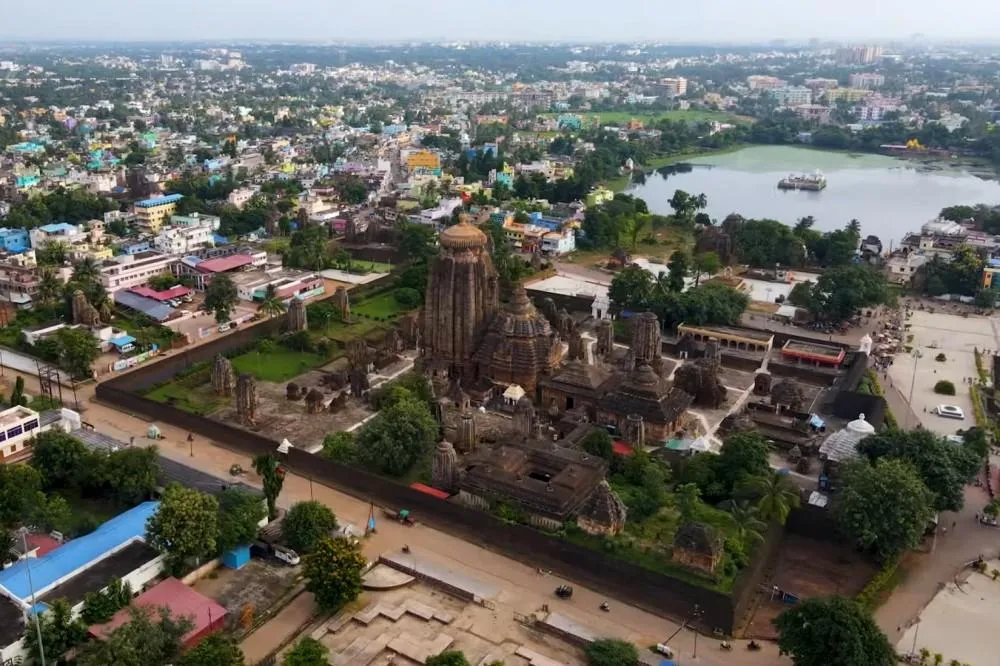
The same tradition connects the creation of the Bindusagar Tank, the large sacred lake just north of the temple, to this episode: Shiva is said to have struck his trident into the ground to draw water from every sacred river and ocean on Parvati’s behalf, taking the name Kirtibasha to mark the occasion. Ritual bathing in Bindusagar before entering the main shrine continues to this day.
Historical Chronology & Dynastic Patronage
The Lingaraj Temple wasn’t built by a single ruler — its structure reflects several centuries of dynastic patronage:
| Period | Development |
|---|---|
| 6th–7th century CE | Early Shaivite worship referenced in early Sanskrit texts; likely small stone/brick shrines under the Sailodbhava dynasty |
| 11th century CE | Somavamsi (Kesari) king Jajati Keshari begins the monumental stone Vimana and Jagamohana; completed under his successor, Lalatendu Keshari |
| 12th century CE | The Eastern Ganga dynasty adds the Natamandira and Bhoga-mandapa, completing the four-chambered layout |
| 1962–present | Managed jointly by the Archaeological Survey of India and the Lingaraj Temple Trust Board |
When the Eastern Ganga rulers took control of the region in the 12th century, they brought a strong Vaishnavite influence with them. Rather than displacing the older Shaiva tradition at Lingaraj, they extended the temple and folded Vishnu worship into it — a step closely connected to the rise of the Jagannath cult in nearby Puri around the same period.
Architecture: The Four-Chambered Layout
Lingaraj is widely regarded by architectural historians as the fullest expression of the Kalinga temple style, arranged along a single east-west axis in four connected halls that rise in height toward the sanctum:
- Bhoga-mandapa (Hall of Offerings) — the outermost hall, where food offerings are prepared and consecrated.
- Natamandira (Dance Hall) — a large pillared hall added later for ritual dance and music.
- Jagamohana (Assembly Hall) — a tiered, pyramidal-roofed hall built to hold devotees before the sanctum.
- Vimana / Garbhagriha (Sanctum tower) — the main rekha deula tower, rising to roughly 55 metres (180 feet), curving gently inward near the top and capped with a stone amalaka and kalasa finial.
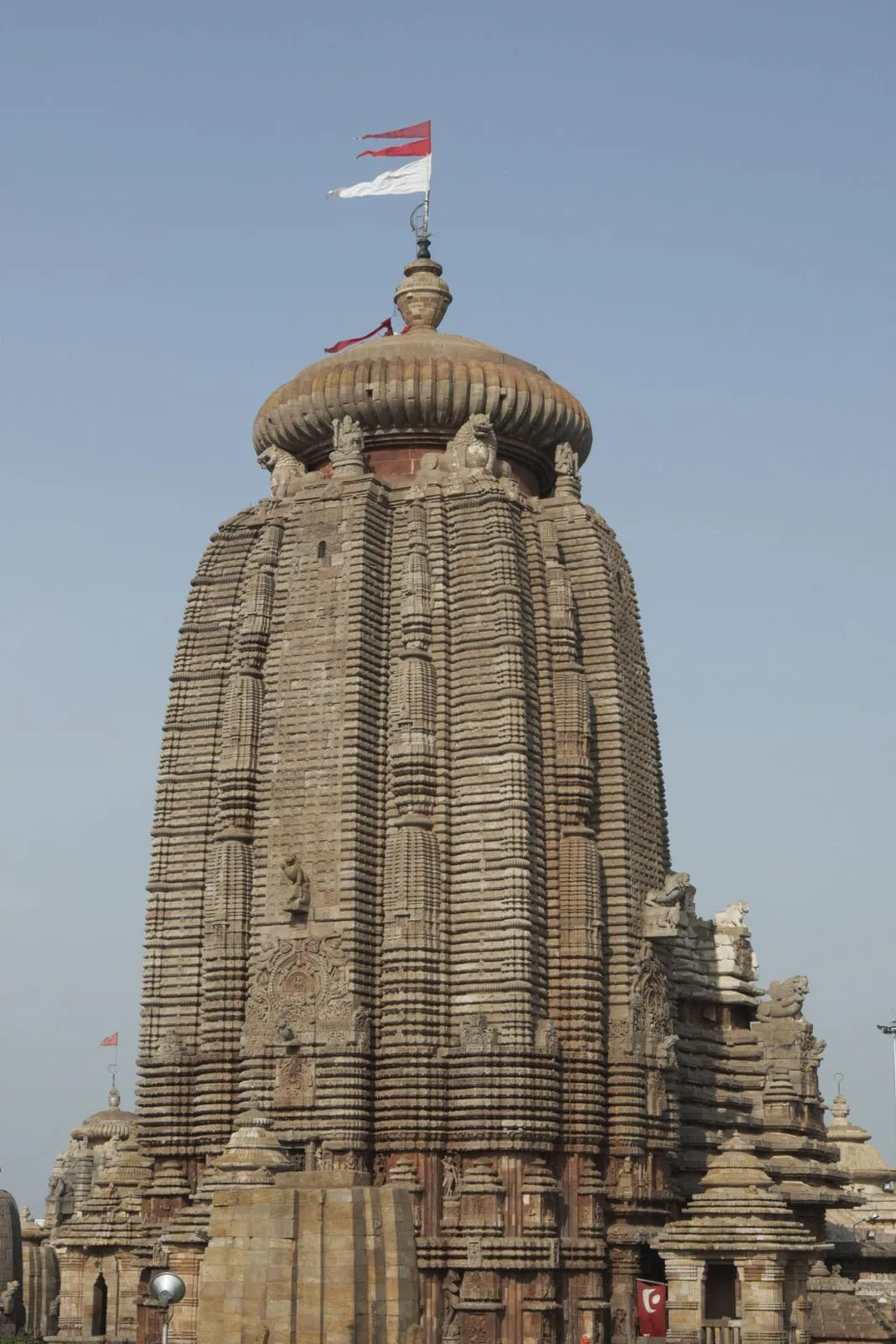
The complex was built from red sandstone and laterite, held together by gravity, corbelling and iron dowels rather than mortar. The tower’s exterior is divided into vertical projections (rathas) carrying detailed relief work, including Alasa Kanyas (women shown adjusting jewellery or playing with pets), Mithuna figures symbolising auspicious union, the eight Dikpala guardian deities, and Gajasinghas — lions shown over subdued elephants, a recurring emblem of Odishan royal power.
Religious Syncretism: Harihara
Lingaraj’s central deity is worshipped as Harihara — Hari (Vishnu) and Hara (Shiva) together in a single Swayambhu lingam — reflecting the way the Eastern Ganga rulers’ Vaishnavism was absorbed into the older Shaiva shrine rather than replacing it. This is visible in the temple’s own iconography and ritual: the spire’s pinnacle carries both Shiva’s trident (trishul) and Vishnu’s discus (chakra) together, and daily worship offers both Bilva leaves (sacred to Shiva) and Tulsi leaves (sacred to Vishnu) to the same lingam.
The Temple Compound & Subsidiary Shrines
The main tower sits within a large rectangular compound wall of laterite blocks, roughly 142 by 158 metres, enclosing what is effectively a small city of temples — Odisha Tourism records around 150 smaller shrines within the compound, built across a span from roughly the 8th to the 14th centuries.
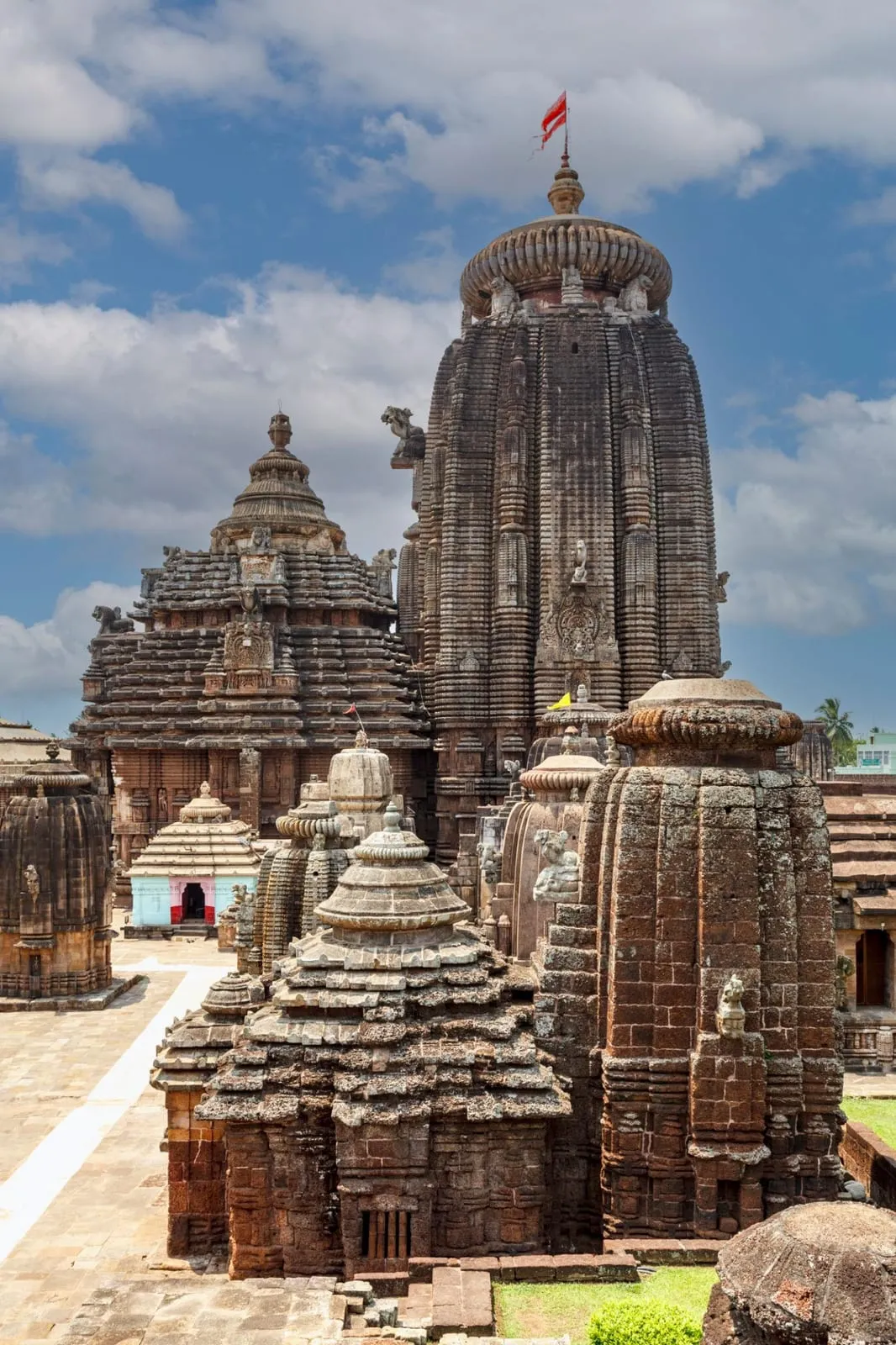
Among the notable subsidiary shrines are the Bhagavati Temple, dedicated to Shiva’s consort, in the compound’s north-western section, and the Ganesha and Kartikeya shrines on the main tower’s side terraces, which house finely finished chlorite carvings of Shiva’s sons.
Rituals, Festivals & Temple Community
Daily worship at Lingaraj follows a sequence known as the Mahasnana: the deity is woken and ritually bathed with water from Bindusagar, dressed and adorned with sandalwood paste, flowers and fine textiles, and offered a multi-course meal at the Bhoga-mandapa.
These rituals are carried out by the Badus, a hereditary community of temple servitors, each of whom passes through ear-piercing, marriage and a formal initiation known as “god-touching” over their lifetime. Tradition holds that King Jajati Keshari brought Vedic Brahmins from across India to work alongside local servitors when the temple was built, establishing the liturgical structure that continues today.
The temple’s largest festival is Mahashivratri, reported to draw upward of 200,000 pilgrims in a single night; devotees fast through the day and stay awake until the Mahadipa, a large lit oil lamp, is carried up the spire’s exterior and lit at the top to mark the fast’s end. In spring, Ashokastami (also observed as the temple’s own Ratha Yatra) sees a representative image of the deity taken in procession on a chariot, the Rukuna Rath, to the Rameshwar Temple a few kilometres away.
Entry Fee & Timings
Entry Fee: Free for all eligible visitors.
Timings: Daily from 5:00 AM to 12:30 PM and 3:30 PM to 9:00 PM (closed during afternoon ritual breaks).
Dress Code & Rules
Faith Restriction: Entry inside the main temple premises is restricted strictly to followers of Hinduism. A designated outer viewing platform — built during the colonial era and still the main way non-Hindu visitors can view the temple today — stands just outside the northern boundary wall. The complex itself is jointly managed by the Archaeological Survey of India and the Lingaraj Temple Trust Board.
Clothing: Modest, traditional attire covering shoulders and knees is mandatory for all visitors.
Electronics & Leather: Mobile phones, cameras, and leather articles are strictly prohibited inside the complex; free and paid lockers/shoe-keeping stations are available near the entrance.
Nearby Places
Rajarani Temple: Famous for its intricate carvings and lack of a presiding deity, located 1.2 kilometers away.
Mukteswara Temple: Celebrated as the “gem of Odissan architecture,” located 850 meters away.
Bindusagar Lake: A sacred water tank situated right next to the temple complex.
How to Reach
Air: Arrive at Biju Patnaik International Airport, located a short taxi ride away from Old Town.
Train: Reach Bhubaneswar Railway Station, situated roughly 4 kilometers from the temple area.