Alarnath Temple, Brahmagiri — History, Anavasara & Visitor Guide
For fifteen days every year, Puri’s most important temple goes dark. After the Snana Yatra bathing ceremony, Jagannath, Balabhadra and Subhadra are believed to fall ill, and the doors close to everyone. It is, for a devotee who has planned a trip around seeing them, the worst possible timing — and for eleven centuries, the answer has been a small temple 25 km down the coast at Brahmagiri.
The Alarnath Temple is where the Jagannath tradition sends its devotees when Jagannath himself is unavailable. Local belief holds that a darshan of Alarnath Dev during this window carries the same merit as seeing Jagannath directly, and during the Anavasara fortnight the road to Brahmagiri fills with people who have made exactly that calculation.
Brahma’s Hill
Temple tradition traces the site back to the Satya Yuga, the first and most distant of the four cosmic ages in Hindu cosmology. Lord Brahma is said to have chosen a hillock here to perform penance to Vishnu. Pleased by the devotion, Vishnu appeared before him and instructed that a deity be carved from a single block of black chlorite stone to mark the spot permanently. Because Brahma had consecrated the ground, the hill and the settlement around it took the name Brahmagiri — “the hill of Brahma.”
That is the temple’s own account of its origins, offered as living tradition rather than as a claim any building can independently verify — but it is worth knowing, because it is the reason the town carries Brahma’s name rather than Vishnu’s, even though the temple itself belongs entirely to Vishnu.
An Eleven-Hundred-Year-Old Stone Temple
Where mythology gives way to history, the record points to King Madan Mahadeva, credited with building the stone temple standing today in roughly the 11th century CE — putting Alarnath at a similar age to Bhubaneswar’s great Kalinga monuments, though far less visited than any of them.
The temple’s name carries a genuinely unusual piece of history. During the early medieval period, its daily worship was conducted by a line of South Indian Brahmin priests belonging to a tradition inspired by the Alvars — the twelve Tamil poet-saints whose ecstatic devotional poetry to Vishnu helped drive the Bhakti movement across South India from around the 6th century onward. Because the deity here was tended by followers of the Alvars, it became known as Alvarnatha — “Lord of the Alvars.” Centuries of local pronunciation wore the name down to Alarnath.
It is a rare, concrete trace of South Indian devotional practice reaching into Odisha’s temple culture, preserved in nothing more than the name on the signboard.
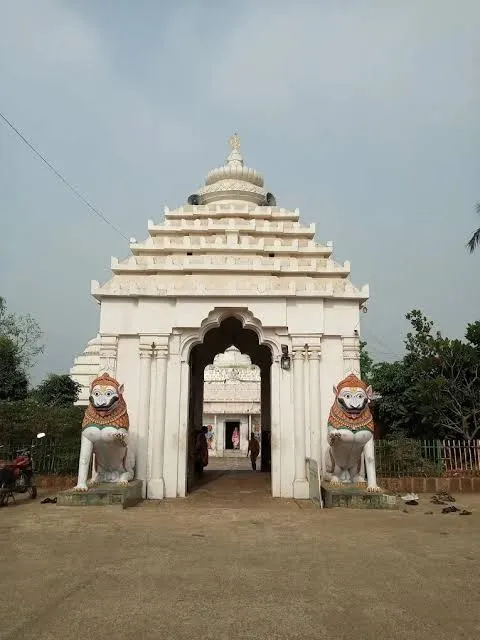
The Deity and the Architecture
The temple follows the standard Kalinga plan — a Vimana housing the sanctum and a Jagamohana assembly hall in front, its walls carved with avatars, celestial figures and floral bands in the same architectural language used across Bhubaneswar and Puri.
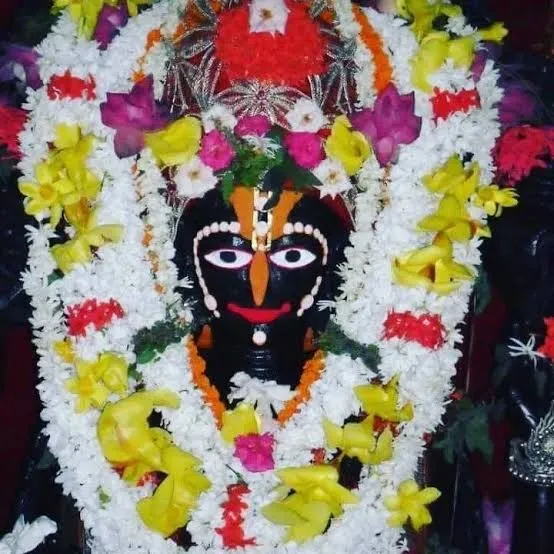
The deity himself is the temple’s centrepiece: a four-armed (Chaturbhuja) form of Vishnu, carved from a single piece of polished black stone. His upper right hand holds the Chakra, his upper left the Shankha; the lower hands carry a Gada and a Padma. Garuda, his divine carrier, kneels at his feet with hands folded in prayer. Subsidiary shrines within the complex hold Lakshmi, and smaller altars for Rukmini and Satyabhama.
Chaitanya Mahaprabhu and the Melting Stone
The temple’s best-known legend belongs to the 16th century and to Sri Chaitanya Mahaprabhu, the saint whose teaching shaped Gaudiya Vaishnavism and much of Bengal and Odisha’s devotional life since.
While living in Puri, Chaitanya is said to have suffered intense spiritual anguish each year when the Jagannath Temple closed for Anavasara — a separation his devotion could not easily bear. Guided, tradition holds, by revelation, he walked the 25 km to Brahmagiri and stood before the four-armed deity of Alarnath. He did not see a separate god. He saw Jagannath himself, present in another form, and fell into full prostration on the stone floor of the temple hall.
The story holds that the heat of his devotion was such that the stone beneath him melted, taking a permanent impression of his body. That slab — the Chaitanya Gauda Patta — is still shown to pilgrims today, resting before the main sanctum as the temple’s most tangible link to its most famous visitor.
The Boy, the Kheer, and the Scalded Fingers
The temple’s daily offering has its own legend, gentler than Chaitanya’s but told with equal conviction.
A priest, away from the village for several days, left his young son in charge of the daily bhoga, telling him simply to make sure the Lord ate. The boy cooked a pot of Kheer — rice, milk and jaggery — and set it before the stone deity, then sat and waited, taking the instruction literally. When nothing moved, he broke down in tears, certain his father would be angry.
Moved, the story goes, by the purity of a child’s devotion rather than by ritual correctness, the deity stepped down from the altar and ate. The boy’s father, told the story on his return, didn’t believe it — until he hid behind a pillar the next day and watched it happen again. Startled into revealing himself, he caused the Lord to hurry back to the altar, spilling hot Kheer across his hands in the process. Priests today point to faint marks on the stone deity’s fingers as the lasting trace of that moment.
The legend is why Alarnath Kheer, cooked daily in earthen pots, remains the temple’s signature offering — and why it is worth trying if it’s available on the day you visit.
Anavasara: The Fifteen Days That Matter Most
This is the reason the temple exists in the wider Jagannath tradition, and the reason to plan a visit around it if the timing allows.
After Snana Yatra, the great bathing festival, Jagannath, Balabhadra and Subhadra are believed to develop fever from the ceremony’s 108 pots of water. For fifteen days — the Anavasara or Anasara period — they are withdrawn from public view inside the Puri temple, tended in isolation until they are ready to reappear for Rath Yatra.
For a devotee whose trip happens to fall in that window, Alarnath is the accepted alternative — a belief strong enough to draw dense crowds to Brahmagiri for the full fortnight, typically landing in June or July. If your dates fall inside Anavasara, this is genuinely the place to be, not a consolation stop.
When to Go
| Reason for visiting | When |
|---|---|
| Full spiritual significance | The 15-day Anavasara period, June–July, right after Snana Yatra and before Rath Yatra — expect real crowds |
| Chandan Yatra festival | 21 days across April–May, with ritual boat processions on the lake behind the temple |
| Calm, comfortable visit | October to March — quiet, cool, and the Kalinga carving is easiest to appreciate without a crowd |
Crowd alert: Sunday afternoons and Monday evenings draw heavier local footfall even outside festival season.
Timings and Practical Notes
Hours: 6:00 AM – 9:30 PM daily, extending during festivals.
Bhoga: Baal Bhoga (breakfast) and a midday meal of rice, dal and vegetables are offered daily, alongside the Alarnath Kheer.
Entry: Free.
Dress: Modest clothing, shoulders and knees covered; footwear left outside the shrine.
Time needed: 45 minutes to an hour outside festival season; considerably longer during Anavasara.
Getting There
Alarnath sits directly on NH-203A in Brahmagiri, about 20–25 km from Puri — a 45-minute taxi or bus ride, and conveniently on the same road that continues on to Chilika Lake at Satapada. That makes it a natural stop to combine with a Chilika day trip rather than a separate outing: Alarnath in the morning, then on to the lake for the afternoon boat ride, with Puri Beach or the Jagannath Temple itself easy to fold in on either end of the day.