Udayagiri & Khandagiri Caves — History, Entry Fee, Timings & Dress Code
The Udayagiri and Khandagiri Caves, carved into two sandstone hills on the outskirts of Bhubaneswar, are among India’s earliest and most significant rock-cut monastic sites. Dating primarily to the 1st and 2nd centuries BCE, the complex was commissioned under the Kalinga king Kharavela and is traditionally said to have originally comprised as many as 117 individual cells, built as monsoon shelters and meditation quarters for wandering Jain ascetics. Today 33 caves survive — 18 on Udayagiri (“Sunrise Hill”) and 15 on Khandagiri (“Broken Hill”) — facing each other across a single road.
Historical Context and Patronage
The site’s history is tied to the Mahameghavahana dynasty, which restored Kalinga’s regional power after the decline of the Mauryan Empire following Ashoka’s war in the 3rd century BCE. In older regional usage, Udayagiri was known as Kumari Parvata (“the Mountain of the Virgin”) and Khandagiri as Kumara Parvata (“the Mountain of the Prince”).
By the 1st century BCE, Kharavela had taken the Kalinga throne. He was a significant military figure who led campaigns across northern and southern India, and — per the site’s own inscriptions — a committed patron of Jainism. Jain monks of the period lived largely itinerant lives, travelling to preach, but were required to halt during the monsoon under their own monastic discipline. Tradition holds that Kharavela, along with his chief queen and court, ordered these twin hills excavated to give monks a permanent place to shelter, rest and meditate during the rains.
The Hathigumpha Inscription
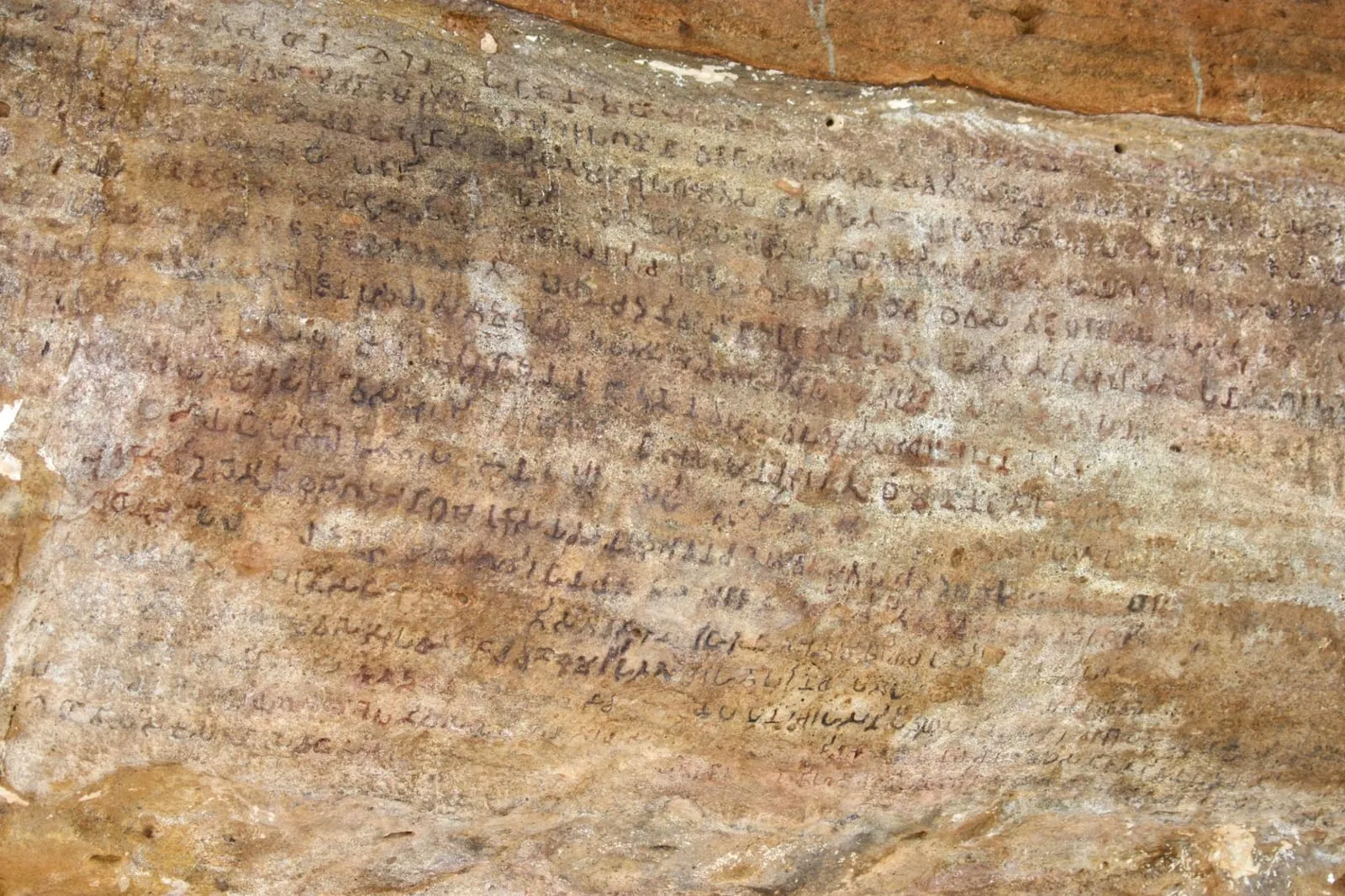
Much of what is known about Kharavela and this early period of Kalinga’s history comes from a single source: the Hathigumpha (“Elephant Cave”) Inscription, carved into the overhanging brow of Cave 14 on Udayagiri. Written in Brahmi script and Prakrit across 17 lines, it was discovered in 1825 by the British officer Andrew Stirling and is read by historians as a year-by-year account of the first thirteen years of Kharavela’s reign.
The inscription describes, among other things: restoration work in the city of Kalinganagara and repairs to irrigation canals originally built under the earlier Nanda kings; military campaigns reaching into the territory of the Satavahana kingdom in the west and the Indo-Gangetic plains in the north, along with the submission of rulers in Magadha; and the recovery of the Kalinga Jina — a Jain Tirthankara idol that the inscription says had earlier been taken as war spoils by the Magadhan ruler Mahapadma Nanda. Its closing lines are generally read as attributing the excavation of the monastic cells on Udayagiri to Kharavela’s patronage of Jain ascetics.
Because so much of Kharavela’s biography rests on this one weathered inscription, readings of individual lines are still debated among historians and epigraphists — but without it, very little would be known about Kalinga in this period at all.
Monastic Engineering and Architecture
The caves at Udayagiri and Khandagiri weren’t built as temples or gathering halls — they’re lenas, austere monastic cells, generally low-ceilinged and narrow enough that monks would have had to sit or lie down rather than stand. Within that minimalism, though, the design shows real attention to practical needs:
- Flooring: cell floors were carved with a slight rise toward the back wall, functioning as a built-in stone headrest.
- Water management: carved channels and runnels directed rainwater into cisterns and storage areas, providing drinking water through the dry months.
- Ventilation and light: dark inner meditation niches open onto shaded pillared verandahs, keeping the cells cool while allowing airflow.
- Security: door jambs were cut with sockets and latch holes so monks could secure wooden doors against animals and weather.
Udayagiri Hill: Notable Caves
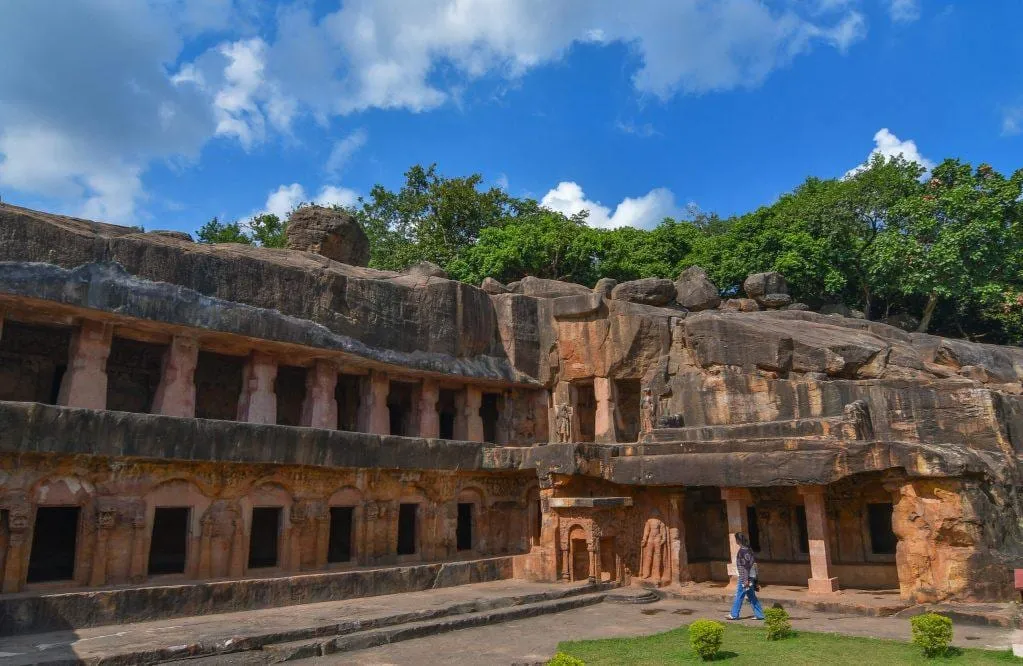
Udayagiri, the larger of the two hills, holds 18 caves, several of which carry detailed historical relief work.
| Cave | Focus |
|---|---|
| Rani Gumpha | Double-storeyed, elaborate royal relief panels |
| Ganesha Gumpha | Elephant guardian statues, Ganesha relief |
| Hathigumpha | The 17-line Brahmi inscription |
| Vyaghra Gumpha | Facade carved as a tiger’s mouth |
| Mancapuri Gumpha | Multi-tier structure with dynastic inscriptions |
Rani Gumpha (Cave 1): The largest and most architecturally complete monastery on the site, a double-storeyed courtyard with open terraces, carved pillars and detailed narrative friezes — hunting expeditions, battles, processions and dance scenes. Scholars debate whether these reliefs depict specific historical events from Kharavela’s court or symbolic episodes from early Jain cosmology.
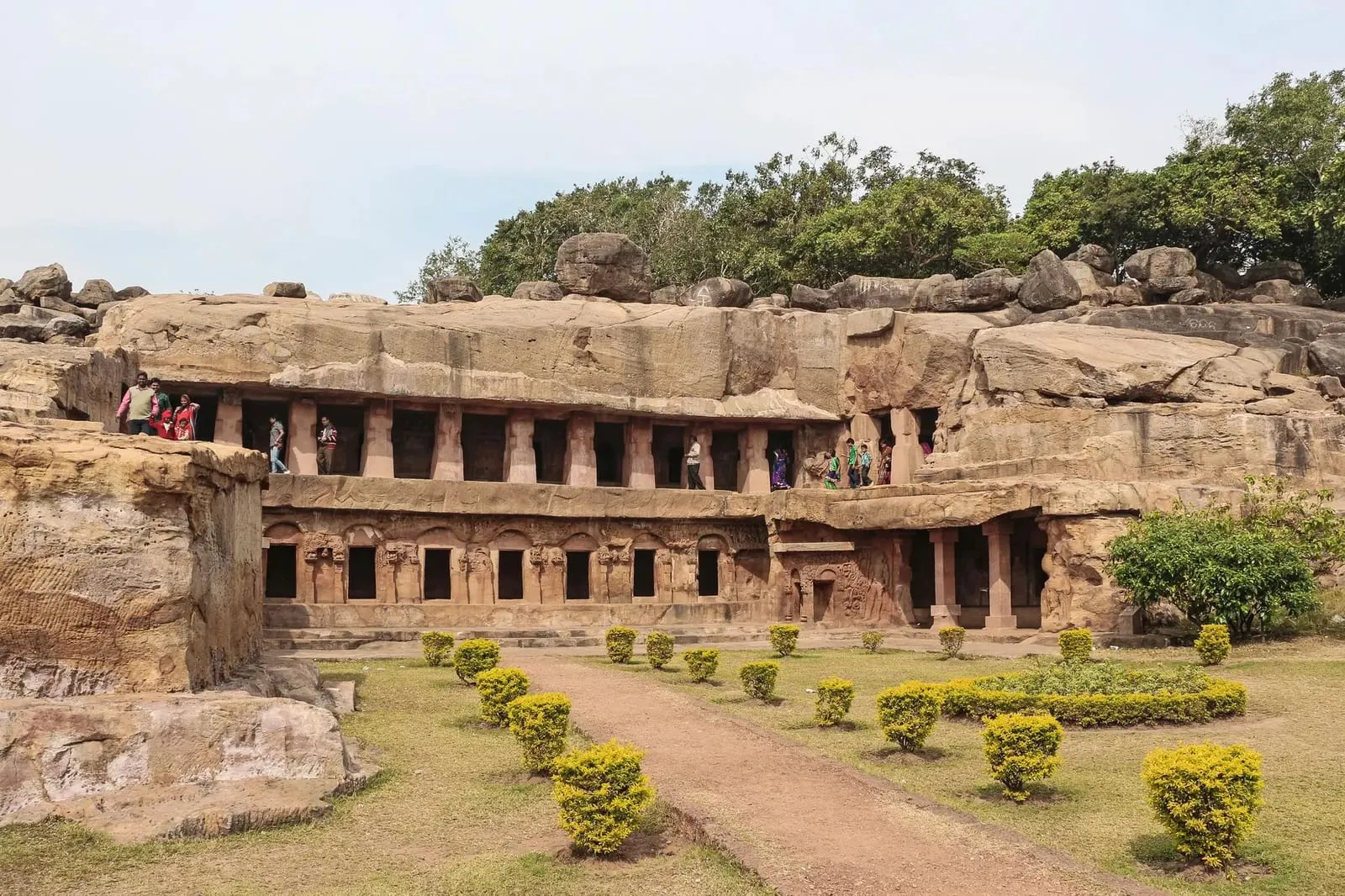
Ganesha Gumpha (Cave 2): Named for a later-carved Ganesha image inside, this cave is best known for the two free-standing stone elephants guarding its entrance stairs, with narrative panels depicting romance, combat and escape in a style related to Rani Gumpha, but on a smaller scale.
Mancapuri and Swargapuri Gumpha (Cave 9): A multi-tiered residence whose dedicatory inscriptions record that its lower storey was funded by Kharavela’s chief queen and its upper levels by later royal family members, including his successors Kudepasiri and Vadukha — epigraphic evidence that royal patronage of the site continued across generations.
Vyaghra Gumpha (Cave 12): Rather than a flat facade, the rock here is carved into the shape of a tiger’s head, with the entrance forming the open mouth and a single monk’s cell inside. An inscription credits its construction to a city judge named Sabhuti.
Khandagiri Hill: Notable Caves
Khandagiri sits across the road from Udayagiri; many of its lower caves show more weathering damage, but it remains important for tracing Jain iconography across a much longer span of time.
Ananta Gumpha (Cave 3): Named for the twin serpents carved above its doorways, generally considered the artistic highlight of Khandagiri — its reliefs include an early depiction of Gaja-Lakshmi (the goddess bathed by two elephants) and a figure resembling Surya driving a sun chariot, alongside trees, animals and athletes.
Navamuni Gumpha (Cave 7): Originally a plain residential cell from Kharavela’s time, it was substantially reworked in the 11th century CE under the Somavamshi dynasty, when reliefs of nine Jain Tirthankaras and their guardian deities (Sasana Devis) were added — evidence the site stayed religiously active for over a thousand years after its original excavation.
Barabhuji Gumpha (Cave 8): Named for two twelve-armed Jain goddess sculptures, this cave carries carvings of all 24 Jain Tirthankaras with their identifying symbols (lanchanas), making it a useful reference point for studying medieval Jain iconography in the region.
Artistic Iconography & Everyday Life
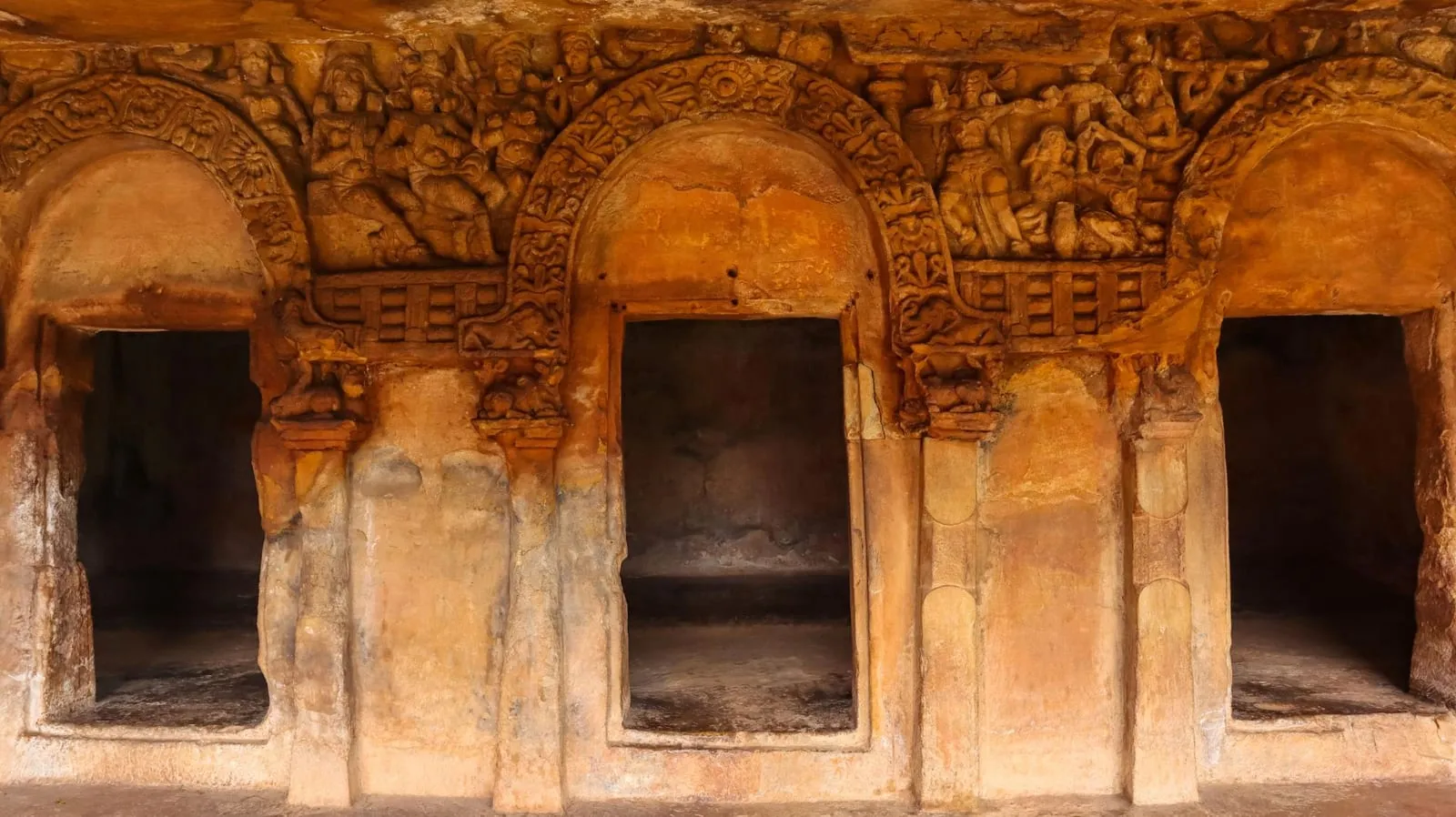
Beyond their religious and historical value, the reliefs across both hills are a window into everyday life in this period:
- Dress: figures are shown in turbans, tunics, layered dhotis and jewellery — a visible contrast with the plain, unadorned life of the ascetics who actually lived in the cells.
- Nature: carved borders feature lotus, mango trees and creepers, alongside elephants, monkeys, lions, deer and birds.
- Warfare: combat scenes show swords, shields, bows and arrows, along with war elephants and chariots.
- Performance: several panels show women dancing on raised stages accompanied by musicians playing harps, flutes, cymbals and stringed instruments.
The Post-Kharavela Evolution
After the Mahameghavahana dynasty declined, new cave construction slowed sharply, but the hills remained an active pilgrimage site rather than falling into disuse. Between the 9th and 11th centuries CE, under the Bhauma-Kara and later Somavamshi rulers, the site saw a renewed wave of activity — existing cells were reworked with new Tirthankara imagery and short dedicatory inscriptions.
In later centuries, a functioning Jain temple was built at the summit of Khandagiri — Odisha Tourism dates the structure to the 18th century — connecting the site’s ancient rock-cut cells to a living Jain tradition that continues today.
Best Time to Visit
The ideal period to visit is from October to February. During these cooler winter months, temperatures range pleasantly between 15°C and 25°C, making the steep outdoor stair climb highly manageable. To avoid intense midday heat and large crowds, plan your tour for the early morning (sunrise) or late afternoon.
Recommended time on site: 1.5–2 hours.
How to Reach
By Air: The site sits just 6 km from the Biju Patnaik International Airport in Bhubaneswar.
By Train: The Bhubaneswar Railway Station is located roughly 8 km away.
Local Transport: Visitors can easily hire auto-rickshaws, city buses, or app-based cabs (Ola/Uber) to drop them directly at the Khandagiri-Udayagiri crossing.
Entry Fee & Timings
The complex is managed by the Archaeological Survey of India (ASI).
Timings: Open every day from 6:30 AM to 7:30 PM.
Entry Ticket Prices:
- Indian Citizens: ₹25 per person (a single ticket covers both hills)
- Foreign Tourists: ₹300 per person
- Children (Under 15): Free
Tip: Booking tickets digitally via the official ASI portal provides a ₹5 discount per ticket.
Dress Code
There is no strict religious dress code enforced for the general cave area, but modest clothing covering shoulders and knees is recommended out of respect for the active Jain Temple atop Khandagiri.
Footwear: Strictly avoid high heels or slippery slippers. Trekking or sports shoes with excellent grip are necessary to climb the uneven, steep rock-cut steps safely.