Raghurajpur Heritage Village, Puri — Pattachitra Art & Visitor Guide
Raghurajpur Heritage Village is India’s first designated heritage crafts village, located in the Puri district of Odisha, celebrated as a living museum where nearly every household functions as an artisan workshop for traditional Pattachitra cloth scroll paintings. Here you’re not visiting a monument — you’re visiting a living tradition, still practised daily inside family homes.
Origins & the Jagannath Economy
Raghurajpur’s history as an artisan village stretches back more than 500 years, to the era of the Gajapati kings of Odisha — rulers such as Kapilendra Deva and Purushottama Deva, under whom art and temple ritual were closely woven into the machinery of the state. The Jagannath Temple in Puri, 14 km to the north, required a continuous supply of ritual paintings, vestments and imagery to sustain its daily worship, and the Gajapati court granted land to specialist painter communities — the Chitrakars — to meet that need.
Raghurajpur, on the banks of the Bhargavi River, was one of the settlements chosen for this purpose; the river’s fertile land supported the coconut and palm groves the village still relies on, and its artists became part of the Chitrakar Niyoga, the guild of painters formally recognised by the temple administration. From its founding, the village’s purpose was to translate Jagannath theology into physical, everyday craft — a role that has shaped its identity ever since.
The Anasara Patti: Art as Ritual Substitute
The tradition that most directly explains Raghurajpur’s long survival is its role in the Jagannath Temple’s own ritual calendar. Each year, during the Hindu month of Jyeshtha, the temple’s wooden deities undergo a ceremonial bath known as Snana Yatra. Afterward, they’re traditionally believed to fall ill, and are kept out of public view for a fortnight — a period called Anasara — inside a private chamber.
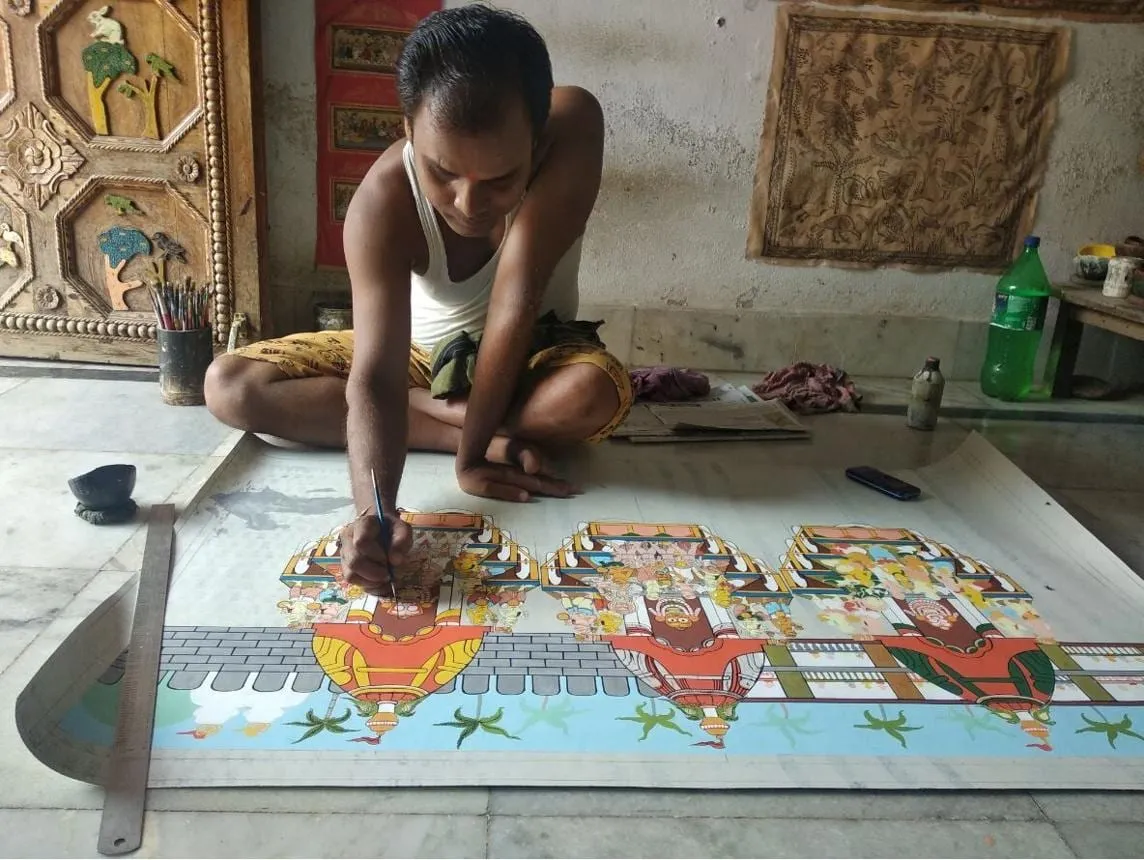
Because the sanctum stands empty during this period, Raghurajpur’s Chitrakars step in: they paint three large cloth canvases, known as the Anasara Patti, depicting the deities in their classical iconographic forms — Ananta Narayan for Jagannath, Ananta Vasudev for Balabhadra, and Bhuaneswari for Subhadra. These paintings are brought to the temple and displayed in place of the hidden idols, so that the pilgrims who continue to arrive throughout the fortnight have an image to pray before. Raghurajpur’s artisans also produce the Chaka Apasara backdrops used beneath the deities’ thrones and paint the chariots for Rath Yatra itself. This yearly, non-negotiable ritual demand is a large part of why the village’s craft survived even as royal patronage for artisan guilds elsewhere in India declined during the colonial period.
Village Architecture & Daily Life
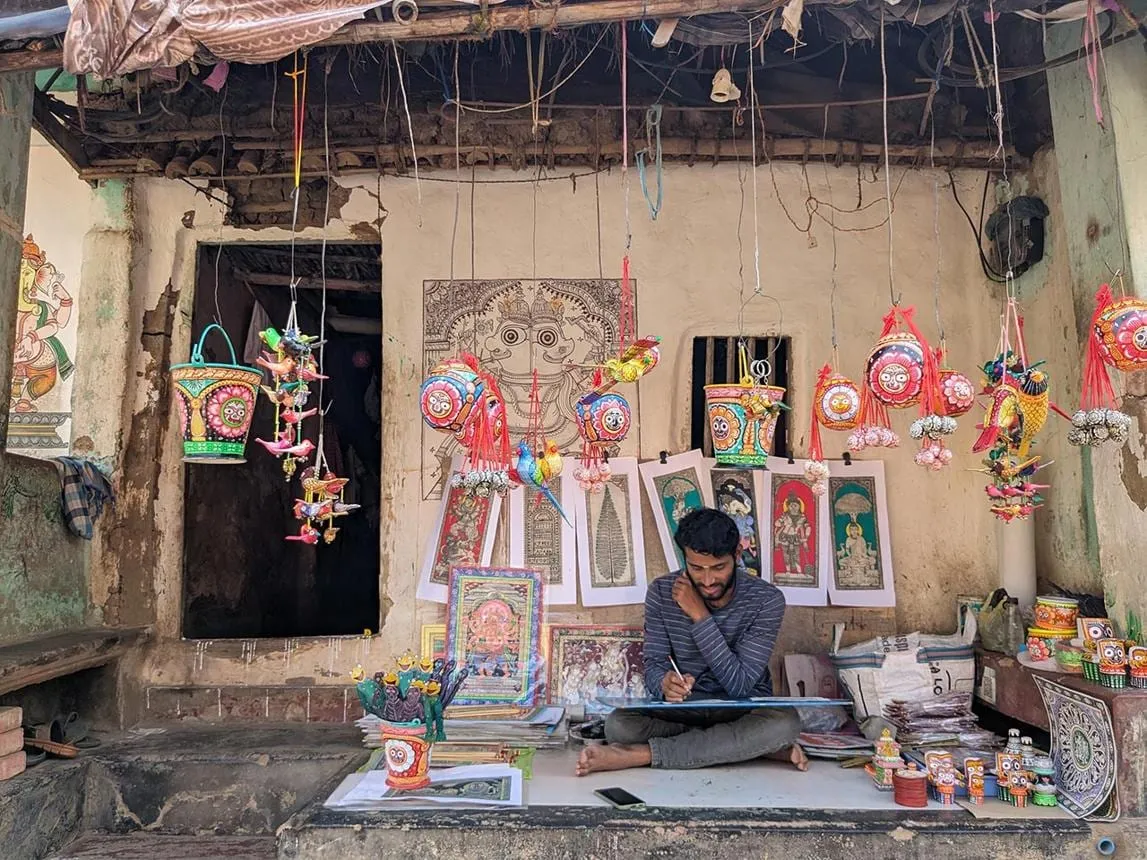
Raghurajpur is laid out as two parallel, tree-shaded streets facing a shared central courtyard, which functions as a communal gathering space and a place to dry finished canvases. Homes are built as low, tile- or thatch-roofed Ghara structures, each with a raised front verandah, or Pinda, that doubles as an open-air studio — family members sit here to sketch, engrave or paint in natural light, in full view of the street. The exterior walls of many homes are themselves painted with murals in the Pattachitra style, giving the village the feel of an open-air gallery. At the ends of the two streets stand small brick shrines dedicated to deities including Radha-Mohan, Gopinath, Laxminarayan, Raghunath and the local protector goddess Bhuasuni — a reminder that the village’s craft and its spiritual life have never really been separate.
Gotipua Dance & Guru Kelucharan Mohapatra
Raghurajpur’s cultural history extends into performance as well as painting. The village is closely associated with Gotipua, a dance tradition in which young boys, dressed and trained to perform as women, present devotional songs to Krishna and Radha — a tradition that emerged as the older Mahari (temple dancer) system declined, and one that’s widely credited as a direct precursor to today’s classical Odissi.
The village’s best-known cultural figure is Padma Vibhushan Guru Kelucharan Mohapatra (1926–2004), born into a Raghurajpur Chitrakar family and trained in the village’s Gotipua and Pattachitra traditions as a child. He’s credited as one of the central figures in reviving and codifying modern Odissi as a classical dance form, and is said to have drawn on the postures and visual geometry of Pattachitra painting in shaping Odissi’s poses. The village has produced other notable performers too, including the percussionist and Odissi proponent Guru Maguni Charan Das.
Crisis, Revival & Today
Raghurajpur’s craft economy wasn’t always secure. Through the late 19th and mid-20th centuries, the decline of royal patronage and the arrival of cheap, mass-produced lithograph prints cut into demand for hand-painted scrolls, and a number of Chitrakar families moved into agriculture or other work to get by.
The turning point came at the end of the 1990s: from 1998 to 2000, the Indian National Trust for Art and Cultural Heritage (INTACH) carried out a two-year documentation project on the village’s art, architecture and traditions, and in 2000 Raghurajpur was formally declared India’s first heritage crafts village. The project restored house facades and murals along the main streets, helped revive fading crafts like papier-mâché mask-making and cow-dung toys, and trained local residents to lead heritage walks — directing tourist income straight to artist families rather than through middlemen.
That resilience has been tested since — Cyclone Fani in 2019 damaged homes and destroyed raw materials across the village — but Raghurajpur has continued to adapt, with artists now also producing Pattachitra on Tussar silk and travelling internationally to exhibit and teach, while still training the next generation of Chitrakars alongside their regular schooling.
Village Overview & Artisan Visits
What it is: A community of master Chitrakars (traditional painters) and craftspeople where visitors can walk directly into family homes to watch art being made live. Odisha Tourism describes the village as home to roughly 120 households, with almost every family traditionally connected to some craft.
Timing & Entry: Open daily from 6:00 AM to 10:00 PM (best experienced in daylight hours when artisans are actively painting). Free entry to the village lanes and individual home-galleries; art purchases are optional.
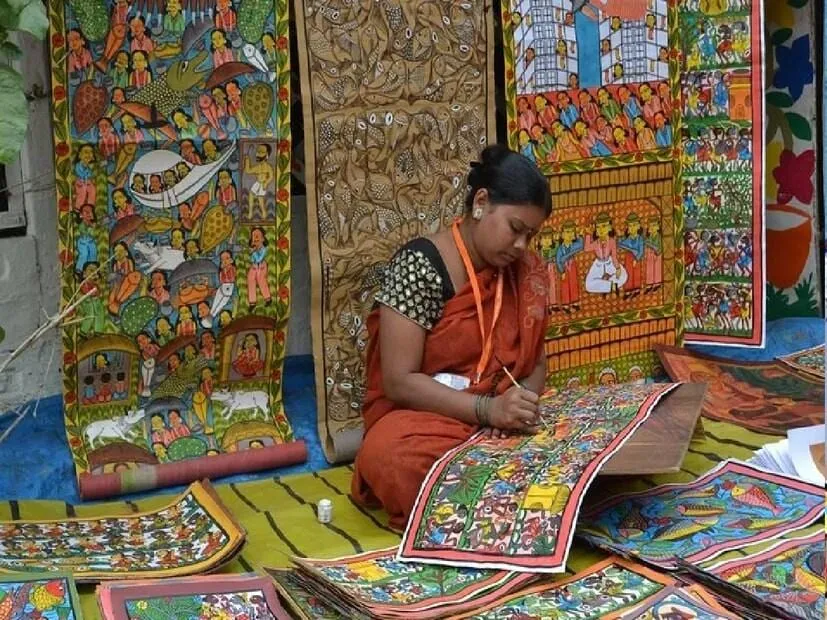
Signature Crafts: Intricate Pattachitra paintings on cotton canvas or Tussar silk using natural stone-and-organic pigments, palm-leaf engravings (Talapattachitra), papier-mâché masks, cow dung toys, and stone/wood carvings.
What Is Pattachitra, and How Is It Made?
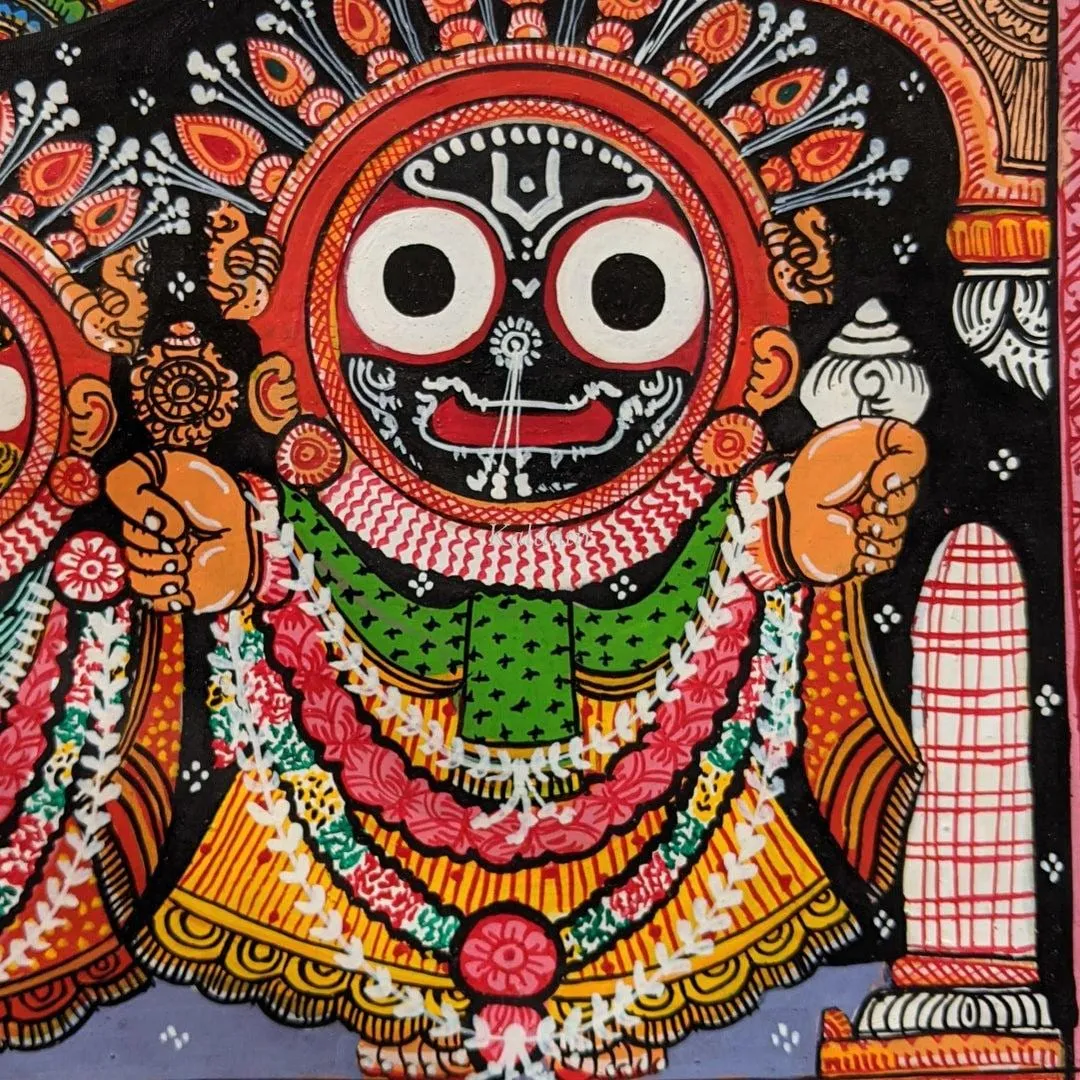
“Pattachitra” is broadly explained as a combination of patta (cloth/canvas) and chitra (painting). The tradition has a strong connection to the iconography of Lord Jagannath and his siblings, and that association with Jagannath culture is part of what gives Pattachitra its particular religious and cultural importance.
A traditional Pattachitra painting is a genuinely involved process, not a quick sketch. In broad terms, an artist:
- Prepares the cloth or canvas
- Treats the surface with natural materials
- Builds up a smooth painting surface
- Draws the traditional outlines
- Applies natural, mineral or organic colours
- Paints the mythological scene itself
- Adds fine decorative borders
- Finishes and seals the work
Traditional subjects commonly include Krishna Leela, the Ramayana, the Mahabharata, Jagannath, and the Dashavatara. Odisha Tourism also notes that Raghurajpur’s artisans are known for the traditional practice of preparing their own paints and brushes by hand.
The traditional palette is built from five natural pigments, sometimes called the Pancha Rasa: white from powdered conch shell, black from lampblack collected off burning castor oil, yellow from the mineral orpiment, red from cinnabar, and blue from indigo or crushed lapis lazuli — all hand-ground and bound with sap from the wood-apple tree. It’s this natural, mineral-based formula that’s traditionally credited with letting old Pattachitra scrolls survive for generations without significant fading.
Beyond Pattachitra, the village is also home to palm-leaf engraving, or Talapatrachitra — a related tradition originally used to preserve sacred texts, in which artists etch scenes from the Geeta Govinda, Ramayana and Mahabharata into boiled, dried palm leaves with an iron stylus, then rub charcoal or lampblack across the surface so the pigment settles into the incised lines — along with Tussar paintings, stone carving, wooden toys and other traditional handicrafts. Odisha Tourism describes the village as an important centre of Odisha’s traditional artistic heritage more broadly.
Notable Local Centers & Workshops
Silpi Guru Dinabandhu Mohapatra Raghurajpur Heritage Village: A prominent family workshop honoring master artisan traditions, open 24 hours daily (contact: +91 80934 89568).
Raghurajpur Prachinekala Pattachitra: Offers deep-dive demonstrations into organic color-making and traditional canvas preparation from cotton and tamarind paste (open 7:30 AM – 8:00 PM; contact: +91 94380 83925).
Heritage Art and Culture Centre (Gotipua Gurukul): Features traditional Gotipua dance previews, cultural hospitality, and authentic local thalis managed by Guru Basant Maharana and team (open 9:00 AM – 10:00 PM).
Visiting Respectfully
Rather than simply buying a painting from a shopfront, it’s worth stepping into an artisan’s home or workshop and asking to see the process itself — a simple, polite request like “could you show us how a Pattachitra is made?” tends to open the door to watching an artist actually work, which is where the craft’s real value becomes clear.
Visitor Tips
Pricing & Shopping: Prices vary widely based on the complexity and size of the artwork (ranging from budget palm-leaf bookmarks to high-end master scroll paintings). Bargaining is common, but buying directly from the creating family ensures fair compensation for the artist.