Konark Sun Temple — History, Architecture, Entry Fee & How to Reach
The Konark Sun Temple, on Odisha’s coast facing the Bay of Bengal, is one of India’s most extraordinary architectural achievements and a UNESCO World Heritage Site. The name “Konark” comes from two Sanskrit words — Kona (corner or angle) and Arka (the Sun) — and the site sat within a region historically known as Arka Kshetra, the “Sun Realm,” a stretch of coastline where the rising sun could be worshipped with an unobstructed view across the sea. Per UNESCO’s record, the present monument was built in the 13th century, during the reign of the Eastern Ganga ruler Narasimha Deva I (1238–1264 CE) — worth noting, since some tourism material describes it as a 12th-century temple, while UNESCO’s documentation places it firmly in the 13th century.
Mythological and Puranic Antiquity
Long before the stone temple that survives today was built, Konark held a place in the mythology of the solar cult. According to Puranic texts including the Samba Purana, Bhavishya Purana and Kapila Samhita, the site’s sanctity is tied to the legend of Samba, son of Lord Krishna.
According to this tradition, Samba was cursed by his father and afflicted with leprosy; the sage Narada advised him to worship Surya, the Sun God, as the healer of skin ailments. Samba is said to have travelled to the Odisha coast, performed twelve years of penance near the confluence of the Chandrabhaga River and the sea, and been cured after bathing in its waters on Surya’s instruction. While bathing, he is said to have found a stone image of the Sun God — fashioned, per the legend, by the divine architect Vishwakarma — and built a temple to house it, establishing Konark as a pilgrimage site long before the 13th-century monument.
The same tradition holds that local Brahmins were initially reluctant to conduct rituals devoted exclusively to the sun, leading to the arrival of Magi (sun-worshipping priests) from Persia. This is a devotional legend, not an archaeologically documented history — but it reflects how old and far-reaching Konark’s association with sun worship was understood to be, well before Narasimhadeva I’s temple existed.
The Eastern Ganga Dynasty & the Politics Behind the Temple
The temple that stands today was built under King Narasimhadeva I, who ruled from 1238 to 1264 CE. Understanding why such enormous resources went into this one stretch of coastline requires some 13th-century political context.
Much of northern and central India was under pressure from the expanding Delhi Sultanate and regional Islamic governments during this period, and many Hindu kingdoms were losing ground or becoming tributaries. The Eastern Ganga rulers of Odisha — from Anantavarman Chodaganga Deva onward — resisted this expansion militarily. When Narasimhadeva I came to the throne in 1238 CE, he took a more aggressive posture than his predecessors, campaigning against the Bengal Sultanate’s forces and securing Kalinga’s northern frontier.
Construction of the temple, begun around 1250 CE, is generally interpreted by historians as tied to these military successes as much as to religious devotion — a monument to Surya, the god associated with light, victory and cosmic order, that also served to project Narasimhadeva’s authority and the stability of his kingdom. This reading of the temple’s political purpose is a widely held historical interpretation rather than a fact recorded on the temple itself.
Architectural Design: The Temple as Surya’s Chariot
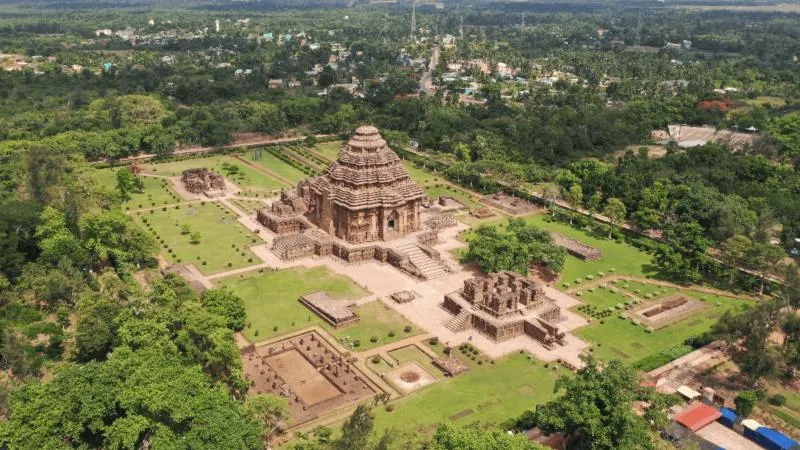
Konark represents the high point of Kalinga temple architecture — a tradition refined over centuries through temples like Mukteswara, Rajarani and Lingaraj in Bhubaneswar and the Jagannath Temple in Puri. Its core layout follows the standard Kalingan sequence, scaled to a far larger size than anything built before it:
| Structure | Role | Approximate height |
|---|---|---|
| Vimana (Deul) | Main sanctum, topped by a curvilinear tower (shikhara) | ~227 ft (69 m) per historical estimates — the tower no longer survives |
| Jagamohana (Mukhasala) | Assembly hall with a pyramidal, tiered roof carrying musician sculptures | ~100 ft, still standing today |
| Nata Mandira | Freestanding pillared dance hall, east of the Jagamohana | Raised on a carved plinth |
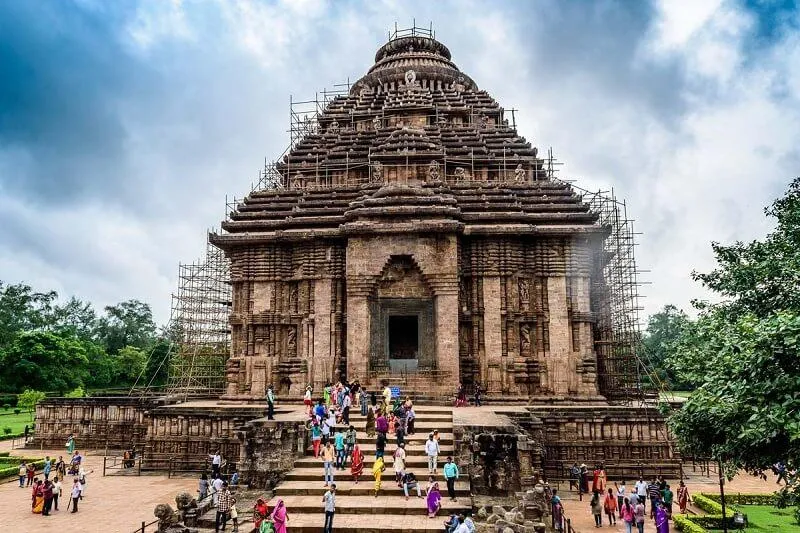
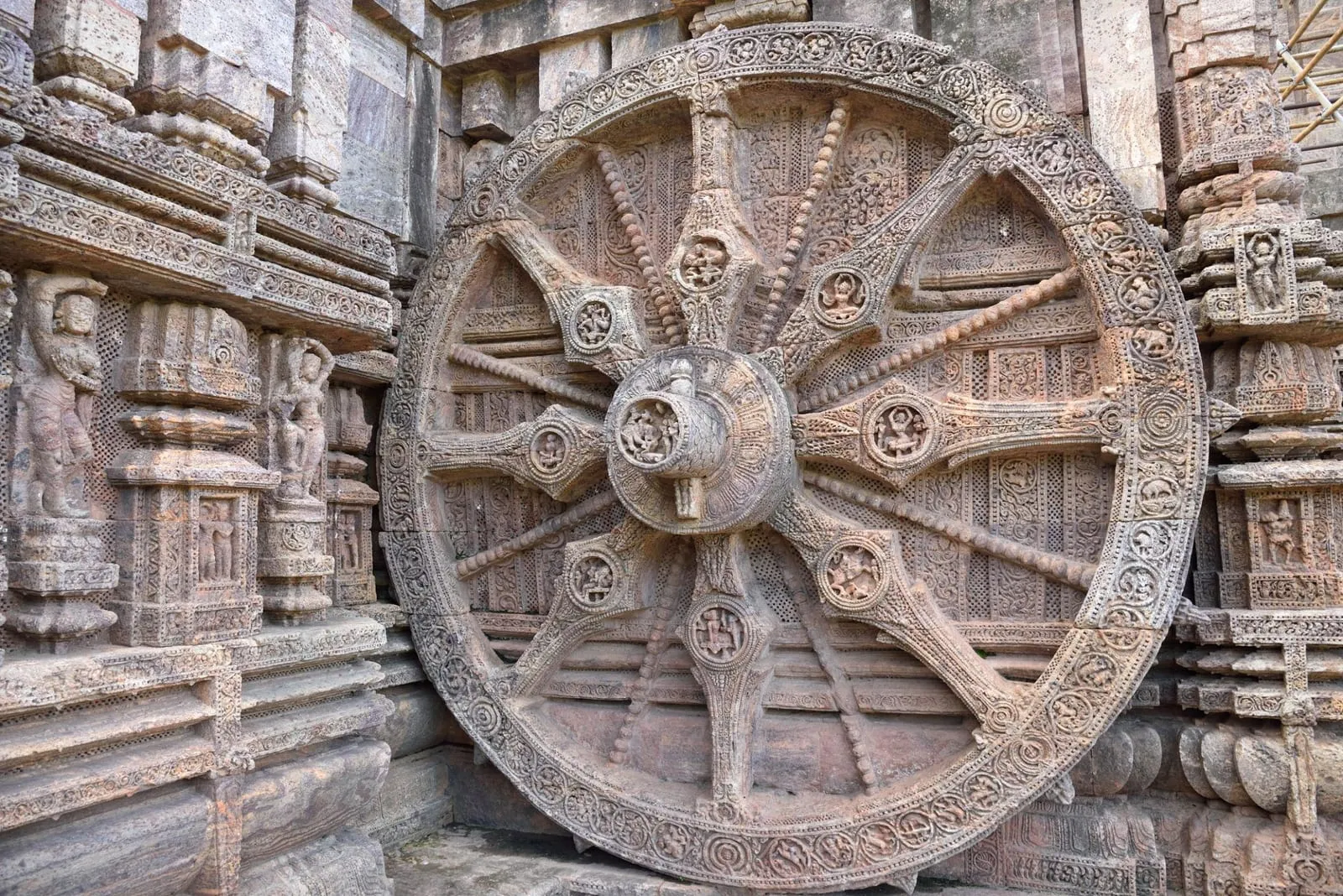
Konark’s defining idea is that this entire complex was conceived as a colossal stone chariot for Surya. Twelve pairs of elaborately carved stone wheels — each over ten feet across — line the plinth, generally understood to represent the 24 fortnights of the year, and seven stone horses appear to pull the chariot eastward, read as a reference to the seven days of the week. It’s a design where the architecture itself becomes a kind of allegory for the movement of time.
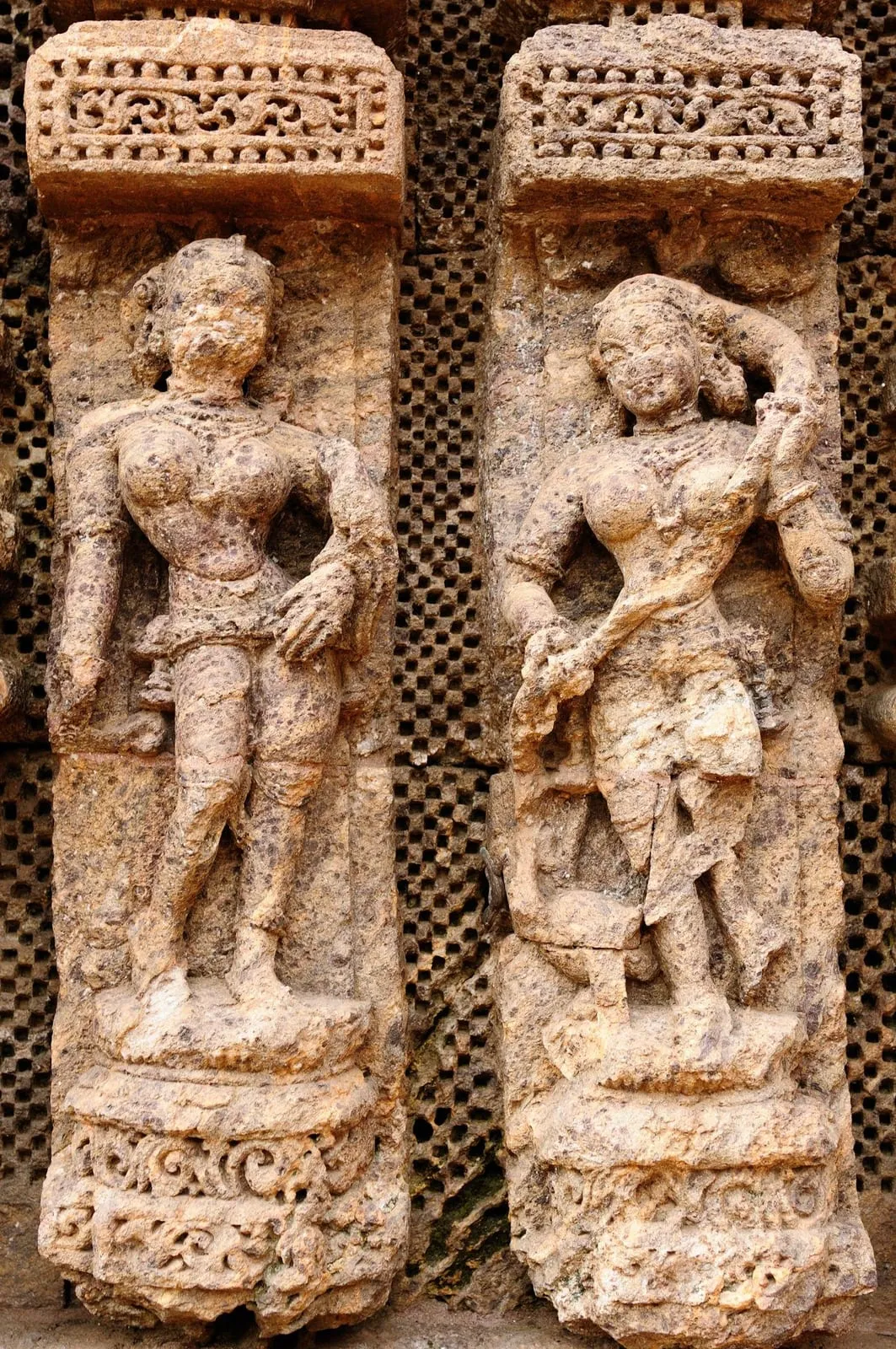
The temple’s walls also carry an extensive sculptural programme — gods and goddesses, musicians, dancers, animals, warriors, royal and everyday social life. Because of this, UNESCO specifically describes Konark as a window onto the social, political and secular life of 13th-century Odisha, not just its religious life.
The Construction Saga & the Legend of Dharmapada
Building Konark required an enormous mobilisation of labour and material. Local tradition and historical administrative records (such as the Baya Chakada palm-leaf manuscripts) describe roughly 1,200 artisans working for twelve years, using three different stones — chlorite for the finer carvings and the main deities, laterite for hidden foundations, and khondalite for the structural mass and reliefs — quarried at a distance and moved to the coast by river and roller.
The human story behind the construction survives in one of Odisha’s best-known folktales: the story of Dharmapada. According to the tradition, the chief architect Bisu Maharana left his pregnant wife to lead the project, vowing not to return until the temple was finished. As the twelve years drew to a close, the story goes, the artisans could not secure the temple’s crowning stone (kalasa), and the king threatened to execute all 1,200 of them if the work wasn’t finished by morning. Bisu’s son, Dharmapada — by tradition a boy of exceptional talent who had grown up without his father — is said to have arrived at the site, identified the fault, and climbed the tower at night to fix it himself. To protect the artisans from the king’s anger at a child succeeding where they could not, Dharmapada is said to have then leapt from the tower into the sea below, so his role would never be known.
This story is treated in Odia culture as a foundational folktale about artistic sacrifice, not a historically documented event — but it remains one of the most widely told stories connected to the temple.
The “Black Pagoda” and Maritime Navigation
For much of its active life, Konark stood directly on the coastline (the sea has since receded some distance). This made the temple’s dark silhouette a landmark for sailors navigating the flat, largely featureless Odisha coast toward Calcutta.
| Konark Sun Temple | Jagannath Temple, Puri | |
|---|---|---|
| Known to sailors as | The “Black Pagoda” | The “White Pagoda” |
| Why | Built of dark khondalite stone, visible far out at sea | Coated in light-coloured lime plaster |
| Role | Navigation marker along the eastern coast | Major regional landmark |
European traders — Portuguese and later British mariners among them — are said to have used the temple’s tower to judge their position at sea, giving rise to a nickname that persisted in colonial-era accounts.
Decline & Theories of Collapse
Exactly how and when the main 227-foot tower collapsed is still debated among historians and archaeologists, and several theories exist rather than one settled explanation.
Invasion (Kalapahad): The most widely cited theory attributes the temple’s desecration to Kalapahad, a general under the Bengal Sultanate, who is recorded as having attacked Odisha’s major temples, including Konark, around 1568 CE. Historical accounts describe damage to the temple’s reliefs and crowning components during this raid; in Hindu temple tradition, damage to the deity or the crowning structure can end a temple’s active ritual life, which may explain why Konark was gradually abandoned by its priests afterward.
Structural and geological failure: Structural engineers have separately proposed that the collapse may have been a slower, cumulative failure — the soft, sandy coastal soil settling under the weight of the tower over decades, combined with corrosion of the iron cramps that held the stone blocks together (the temple used no mortar), and repeated damage from cyclones. On this reading, any human desecration would have combined with, rather than solely caused, a building that was already structurally vulnerable.
The lodestone legend: A well-known local legend holds that a massive magnet was placed at the top of the tower, supposedly keeping the sanctum’s Sun idol suspended in mid-air and powerful enough to disrupt the compasses of passing ships — and that sailors eventually removed the stone, destabilising the tower and causing its eventual collapse. This story isn’t supported by modern archaeological evidence, but it’s a well-known part of Konark’s popular history and speaks to how much technical sophistication later generations attributed to its builders.
British-Era Restoration
By the early 19th century, the main tower had fully collapsed into rubble, the site was buried under wind-blown sand, and it had been overgrown by jungle. Materials from the ruins were also scavenged for reuse elsewhere — most notably, the finely carved Aruna Stambha (a chlorite pillar depicting Surya’s charioteer Aruna) was removed in the 18th century and installed in front of the Jagannath Temple’s Lion’s Gate in Puri, where it still stands today.
Colonial-era administrators eventually intervened to save what remained. In 1900, Lieutenant-Governor Sir John Woodburn launched an effort to protect the surviving Jagamohana. In 1903, engineers under T. A. Garland sealed its four entrances and filled the entire interior with sand, capping it with stone — a drastic but effective measure that kept the walls from buckling under the weight of the roof, even though it has kept the hall’s interior closed to visitors ever since.
UNESCO World Heritage & Modern Legacy
UNESCO inscribed Konark as a World Heritage Site in 1984, under three criteria: exceptional artistic achievement (criterion i), its testimony to the 13th-century kingdom of Odisha (criterion iii), and its association with religious and cultural traditions connected to Surya worship (criterion vi). Since Indian independence, the Archaeological Survey of India has cleared the sand dunes that once buried the site, exposing the wheels, the plinth reliefs, and smaller structures within the complex such as the Mayadevi and Vaishnava temples.
Konark’s legacy extends well beyond the monument itself. One of its carved wheels, with its astronomically precise spokes, appears on the back of the Indian ten-rupee note. Every December, the temple’s freestanding Nata Mandira becomes the venue for the Konark Dance Festival, where classical dancers perform Odissi, Bharatanatyam, Kathak and other traditional forms in the open air. And in 2022, the ASI began a modern engineering project — using laser scanning and internal cameras — to examine and eventually remove the century-old British sand-fill from inside the Jagamohana, aiming to stabilise and one day reopen its interior.
Entry Fee & Timings
Timings: The monument complex is open daily from 6:00 AM to 8:00 PM.
Entry Ticket Cost:
- Indian Citizens / SAARC & BIMSTEC Visitors: ₹40 per person
- Foreign Tourists: ₹600 per person
- Children (Under 15 Years): Free
Konark Light & Sound Show: Tickets cost roughly ₹30. The show operates every evening (except Mondays) using high-tech laser projections and wireless headphones available in English, Hindi, and Odia. Bookings can be made directly on the government portal Book Odisha.
How to Reach
Konark is seamlessly connected via the Odisha Golden Triangle route linking Bhubaneswar, Puri, and Konark. A popular day-trip sequence from Puri is Puri → Konark → Chandrabhaga Beach → Raghurajpur → Puri, often combined in a single day — an early start is worth planning for, since the stone surfaces get uncomfortably hot in the afternoon sun.
By Air: Fly into Biju Patnaik International Airport (BBI) in Bhubaneswar, which sits roughly 65 km away.
By Train: The nearest major railway head is Puri Railway Station, located just 35 km away, and about 35 km by road from Konark.
Recommended time on site: 2–3 hours.