Dhauli Shanti Stupa — History, Entry Fee, Timings & How to Reach
The Dhauli Shanti Stupa, also widely known as the Peace Pagoda, is a historic Buddhist monument perched atop the Dhauligiri Hills on the banks of the Daya River, located about 8 kilometres south of Bhubaneswar, Odisha. The Dhauli and Daya River area is traditionally associated with the battlefield of the Kalinga War of 261 BCE — a conflict whose aftermath is closely linked to Emperor Ashoka’s later turn toward Buddhism and non-violence.
The Kalinga War (261 BCE)
Before it became a sanctuary of peace, Dhauli was a battlefield. In 261 BCE, the Mauryan emperor Ashoka campaigned against the prosperous, independent state of Kalinga, and the Dhauli and Daya River region is traditionally associated with the site where that war reached its bloody conclusion. Historical estimates suggest the toll was enormous — figures commonly cited put the dead above 100,000, with roughly 150,000 more driven out as captives, though exact numbers from a conflict this old should be read as estimates rather than precise counts.
Local legend goes further still, holding that the slaughter was so severe that the adjoining Daya River ran red with the blood of the fallen — a vivid tradition, passed down rather than historically documented, but one that captures how the scale of the war is remembered in the region.
Ashoka’s Transformation
The aftermath of the war at Dhauli is closely tied to one of the most significant turns in Indian history. Tradition holds that looking out over the battlefield — the dead, the grieving survivors — Ashoka was overcome with remorse, and that this moment crystallised his rejection of conquest by force (Dig-Vijaya) in favour of conquest through moral example and dharma (Dharma-Vijaya).
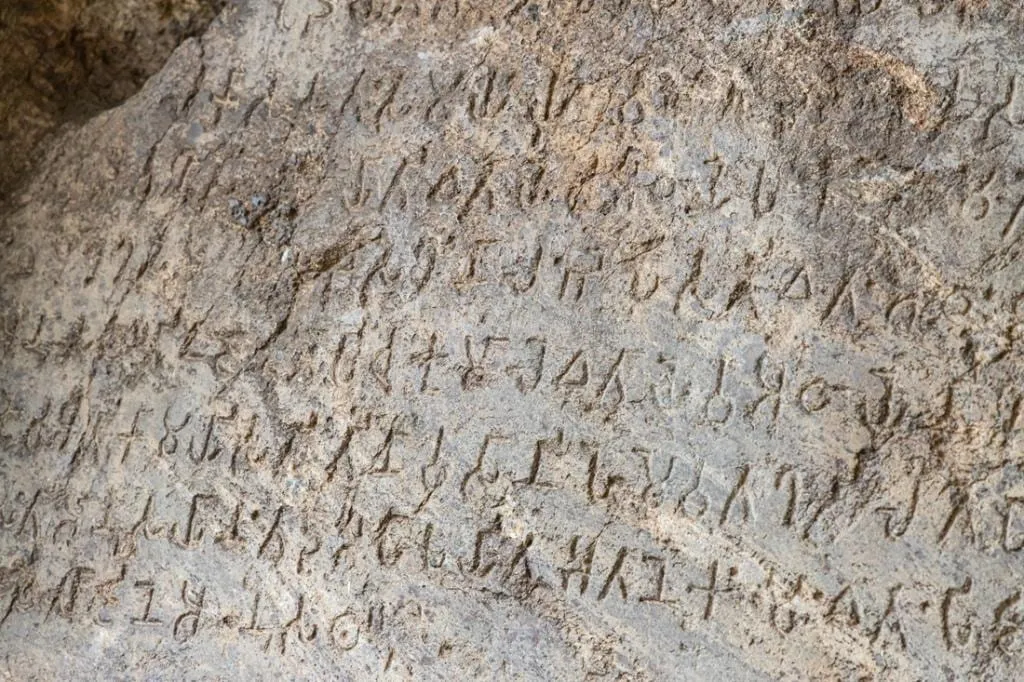
It’s worth being careful with this history, though — the idea that Ashoka “converted to Buddhism the day after the battle” is a common oversimplification. Ashoka’s own inscriptions show a clear development of his commitment to dhamma, welfare and non-violence in the years that followed, and his association with Buddhism is well documented — but that shift is better understood as a gradual transformation than a single dramatic moment. The Dhauli battlefield is best understood as the turning point that set that transformation in motion, rather than the single instant it was completed.
The Ashokan Rock Edicts & Elephant Sculpture
At the base of the hill lie the famous Ashokan Rock Edicts, carved directly into the rock face in the Prakrit language using Brahmi script. Rather than declarations of military victory, the edicts lay out instructions on benevolent governance, religious tolerance and compassion for living beings — the Archaeological Survey of India’s protected-monument listing specifically records Ashoka’s rock inscription at Dhauli, along with the carved elephant sculpture above it, as a protected monument.
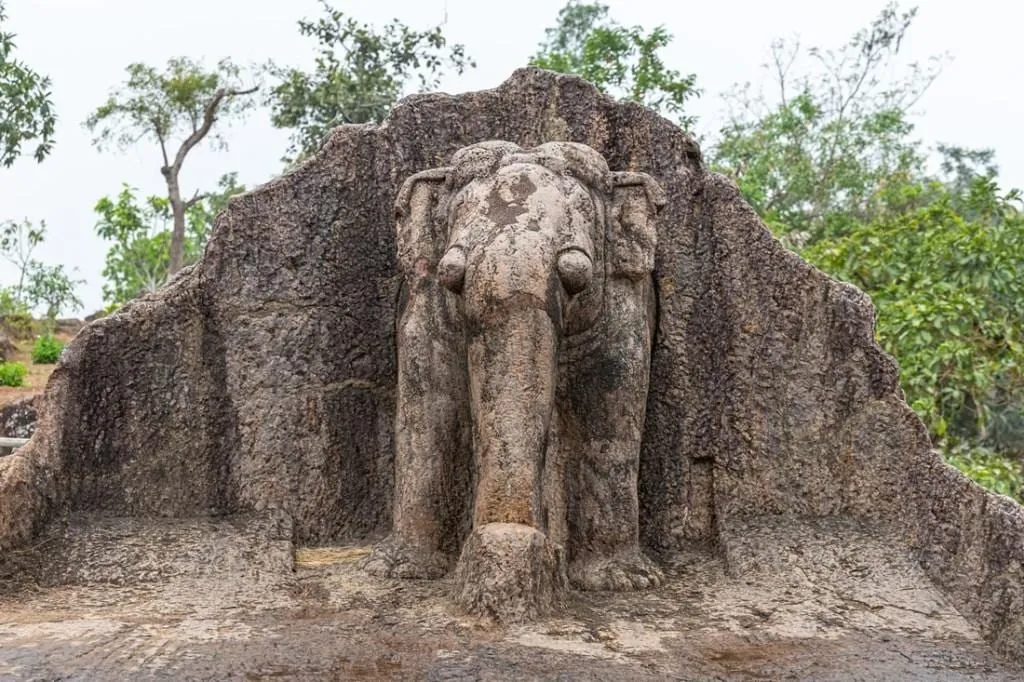
Just above the edicts, the head and forelegs of an elephant emerge from the rock face, dated to the 3rd century BCE and widely considered the oldest rock-cut sculpture in India. The elephant is traditionally understood to symbolise the birth of Gautama Buddha and the emergence of enlightenment from the stone itself.
The Shanti Stupa (1972)
For centuries after the Mauryan period, Dhauli remained largely an archaeological site. It was revived as a living monument to peace in 1972, when the Japan Buddha Sangha and the Kalinga Nippon Buddha Sangha collaborated to build the white, dome-shaped Shanti Stupa (Peace Pagoda) on top of the hill.
The structure’s stone panels depict scenes from the Buddha’s life and teachings — his footprints, the Bodhi tree, and a relief carving showing Ashoka renouncing his sword — while four golden statues of the Buddha face the cardinal directions, looking out over the plains where the war is traditionally believed to have taken place.
Multi-Religious Heritage Nearby
While its Buddhist history is what Dhauli is best known for, the hill and its surroundings have grown into a multi-faith site over the centuries. The Dhavaleswar Temple, an old Shiva temple near the hills, draws large crowds during Mahashivratri, and the nearby Bahirangeswar and Ganesha temples add further layers to the site — a reminder of how later traditions settled alongside the older Buddhist and Mauryan-era heritage rather than replacing it.
Best Time to Visit
Ideal Months: October to February offers pleasant weather. This makes exploring the outdoor hilltop complex comfortable.
Time of Day: Early morning is perfect for beating the crowds and catching the sunrise. Alternatively, late afternoon allows you to stay back for the stunning sunset and evening show.
Annual Festival: Visiting in February lets you experience the three-day Kalinga Dhauli Mahotsav, a vibrant celebration of classical dance, music, and martial arts organized by Odisha Tourism.
How to Reach
By Air: The monument is roughly 11 km from the Biju Patnaik International Airport (BBI) in Bhubaneswar.
By Train: The nearest major railhead is the Bhubaneswar Railway Station, situated about 10 km away.
Entry Fee & Timings
The complex remains open throughout the week.
| Feature / Activity | Timings | Cost per Person |
|---|---|---|
| Main Stupa & Complex Access | 6:00 AM – 6:30 PM daily | Free Entry (nominal vehicle parking charges apply) |
| Light & Sound Show (First) | 7:00 PM – 7:35 PM (closed Mondays) | ₹25 for Adults / ₹10 for Students |
| Light & Sound Show (Second) | 7:45 PM – 8:20 PM (closed Mondays) | ₹25 for Adults / ₹10 for Students |
Dress Code & Conduct
There is no strict or mandatory dress code enforced for the complex. However, because it serves as an active Buddhist pilgrimage destination and a sacred historical site, visitors are strongly encouraged to dress modestly (covering shoulders and knees). You must remove your footwear before stepping onto the main raised platform of the Peace Pagoda.